
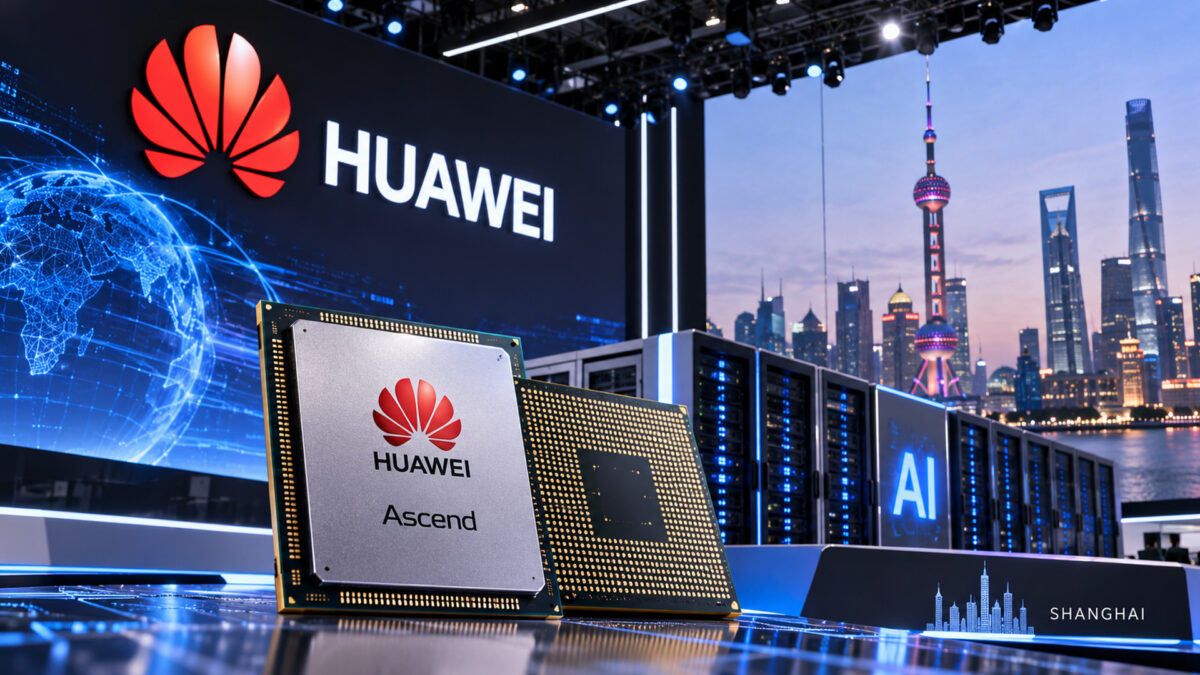
Huawei is moving faster in the artificial intelligence chip race, bringing forward the launch of its next-generation processors as China works to build a stronger domestic alternative to Nvidia.
The Chinese technology giant said it will launch two new AI chips in 2027. The Ascend 960DT is expected in the first quarter, while the Ascend 960PR will follow in the third quarter. The announcement was made at Huawei’s annual Connect conference in Shanghai on September 17.
The new timetable is earlier than Huawei had previously indicated. The company had earlier planned to release the Ascend 960 later in 2027. Splitting the product into two versions also reflects the different demands of AI workloads, including training large AI models and running AI applications after they have been developed.
Huawei’s move comes as demand for AI computing in China continues to grow. Eric Xu, one of the company’s rotating chairmen, said Huawei currently does not have enough production capacity to meet demand inside China. That shortage is also limiting the company’s ability to expand its AI hardware business overseas.
The situation highlights how important AI chips have become to China’s technology industry.
Powerful processors are needed to train and operate advanced AI models. Nvidia has built a dominant position in this market through its high-performance chips and CUDA software platform, which is widely used by AI developers.
Huawei is trying to build an alternative.
Its Ascend series has become one of the most important Chinese alternatives to Nvidia’s AI processors. US restrictions on the export of advanced semiconductors and chipmaking technology to China have added urgency to that effort.
Huawei executives say the company is gaining ground in the Chinese AI chip market. Xu has claimed that Ascend has a larger share of the domestic market than Nvidia, although Huawei did not provide figures to support the claim. Nvidia, meanwhile, continues to have a significant advantage in AI software and developer support.
Huawei is also taking a different approach to improving computing power.
Instead of relying only on making a single chip more powerful, the company is working on technologies that allow large numbers of processors to operate together. Its UnifiedBus technology is designed to connect processors with memory, storage and networking components so they can function as part of a much larger computing system.
The company has developed 11 semiconductors using the technology and says its systems can eventually connect up to one million AI processors. Huawei has already shipped more than 1,000 such AI computing systems to more than 370 customers.
This approach is becoming increasingly important as AI models grow more complex. Training a large model can require thousands of processors working simultaneously. Connecting chips into clusters can therefore increase overall computing capacity even when an individual processor cannot match the performance of the most advanced Nvidia chips.
Huawei has unveiled the Atlas 960 SuperPoD as part of this strategy. The company is developing larger AI computing systems that combine its processors, networking technology and other hardware into a single platform.
The company has also laid out a longer-term roadmap. Huawei plans further generations of Ascend processors, including the Ascend 970 in 2028 and Ascend 980 in 2029. It has said future generations will continue to deliver substantial increases in computing performance.
The rapid development comes despite significant challenges.
US export controls have restricted Chinese companies’ access to some advanced AI chips and semiconductor manufacturing equipment. Huawei has also faced limitations in obtaining the most sophisticated chipmaking technology, making it harder to compete directly with the latest processors produced by companies such as Nvidia.
That has pushed Huawei to focus on efficiency, chip design, networking and large-scale systems rather than competing on individual chip performance alone.
Software is another important part of the competition. Nvidia’s CUDA platform has become deeply embedded in AI development, giving the US company a large ecosystem of developers and applications. Huawei is working to expand its own software ecosystem and attract Chinese AI developers to its Ascend platform.
The company says more than 40 AI models have already been trained using its systems, while its developer community continues to expand.
China’s push for AI self-reliance is giving Huawei an important domestic market. Chinese technology companies are increasingly looking for locally developed chips and computing systems as US-China technology restrictions reshape the semiconductor industry.
The competition, however, is no longer simply about who makes the fastest AI chip. It is becoming a broader contest involving processors, software, networking, memory, data centres and the ability to connect thousands of chips into a single AI computing platform.
Huawei’s accelerated 2027 roadmap shows how quickly that contest is developing. The company is preparing to release new AI chips almost every year while building the infrastructure needed to support increasingly demanding AI applications.
Whether Huawei can close the remaining technology and software gap with Nvidia will depend on its ability to improve chip performance, expand production and strengthen its developer ecosystem.
But one thing is becoming clear: China’s AI ambitions are creating a rapidly expanding market for domestic AI chips, and Huawei intends to play a central role in it.