
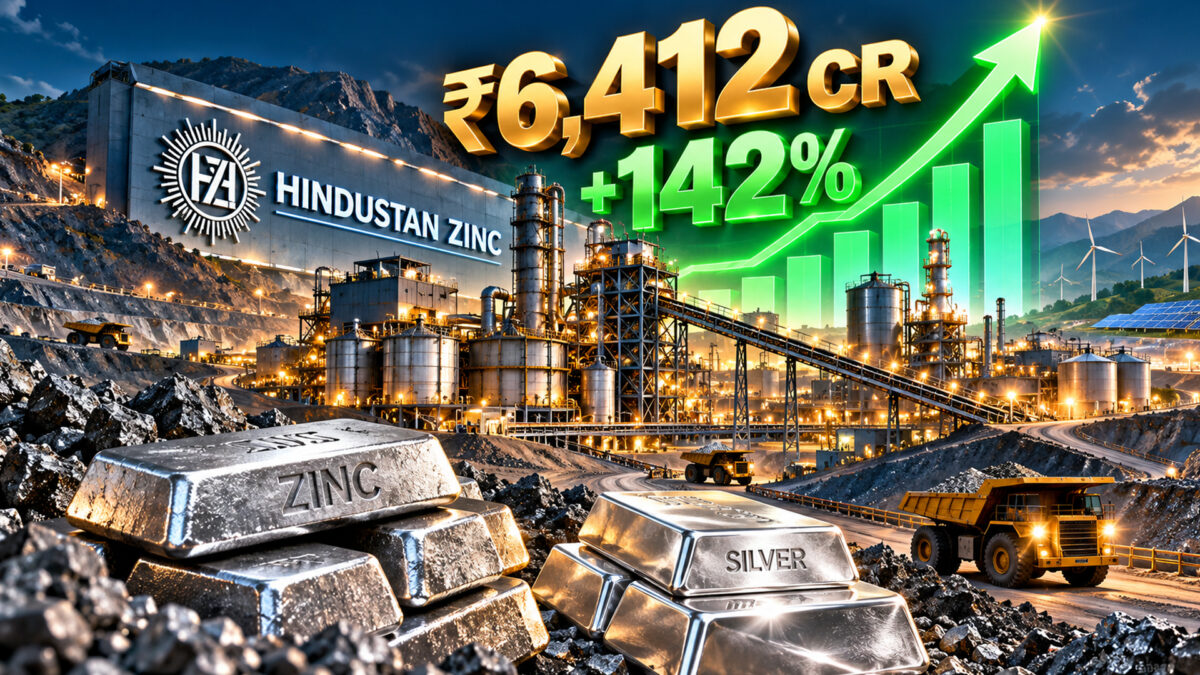
Hindustan Zinc reported a sharp rise in quarterly profit as higher zinc and silver prices, increased production and lower operating costs strengthened its financial performance. The Vedanta Group company recorded a 142% year-on-year jump in consolidated net profit to ₹6,412 crore for the July-September quarter of the 2026-27 financial year. Revenue also reached a record ₹15,093 crore, highlighting the benefit of favourable metal prices and improved production.
The company’s net profit stood at ₹2,649 crore in the corresponding quarter last year. Revenue from operations increased 76.5% from ₹8,549 crore a year earlier, reflecting stronger sales across its key metals business.
Hindustan Zinc‘s earnings before interest, tax, depreciation and amortisation (EBITDA) more than doubled to ₹9,285 crore, compared with ₹4,467 crore in the year-ago period. Its EBITDA margin expanded to 62% from 52%, showing that the company was able to convert a larger share of its revenue into operating earnings.
The results, announced on October 19, underline the importance of higher metal prices and operational efficiency for the mining sector. The company benefited from stronger realisations, increased output and improved returns from by-products.
Hindustan Zinc also reported a 29% year-on-year decline in zinc production cost, excluding royalty, to $703 per tonne during the quarter. Better ore grades, higher production and increased renewable power consumption helped lower costs, although some input expenses remained elevated.
Zinc remained the company’s largest revenue contributor. Revenue from zinc sales rose 54% year-on-year to ₹8,224 crore, supported by higher prices and increased production.
Silver provided another major boost. Revenue from silver sales surged 141% to ₹4,111 crore, while silver production increased 20% to 173 tonnes. Stronger silver prices and greater output helped the company benefit from demand for precious metals.
Revenue from lead sales increased 35% to ₹1,130 crore. The improvement across its main products helped Hindustan Zinc deliver record quarterly revenue.
Global zinc prices have received support from concerns about supply constraints and the possibility of a market deficit. Mine closures and declining ore quality at some operations have raised concerns about the availability of refined zinc. These conditions have supported prices, although changes in industrial demand and global economic growth could influence the market in the coming months.
Hindustan Zinc is a major supplier to India’s zinc market, with operations covering mining, processing and refining. Zinc is widely used in galvanised steel, construction, infrastructure and manufacturing, while silver serves both investment and industrial demand.
The company recorded mined metal production of 271,000 tonnes in the September quarter, up 5% from a year earlier. Refined metal production increased 7% to 264,000 tonnes, marking a record for the second quarter.
Higher output allowed Hindustan Zinc to benefit from favourable market prices while spreading production costs across larger volumes. Improved mined grades and operational efficiencies also supported the reduction in zinc production costs.
The company said its performance reflected the strength of its operations and continued focus on productivity. Management has also highlighted plans to use artificial intelligence and other technologies to improve efficiency and support future growth.
Hindustan Zinc has reduced its zinc production cost forecast for the full 2026-27 financial year to $825-$850 per tonne from its earlier estimate of $975-$1,000 per tonne.
Chief Executive Amarendu Prakash attributed the revised outlook to improvements in production efficiency and cost management. The company’s September-quarter cost of $703 per tonne was significantly lower than the previous year’s level.
However, the benefit from higher realisations for sulphuric acid, a by-product of zinc production, depends on market prices and may not continue at the same level. The company also faces pressure from certain input costs, making sustained efficiency improvements important.
Hindustan Zinc expects the global refined zinc market to face a supply deficit of around 180,000 tonnes in 2026. Mine closures and declining ore grades are among the factors expected to limit supply. A tighter market could support zinc prices, although the outlook will depend on demand from industrial sectors.
Expansion and diversification plans
The company is progressing with a planned integrated zinc expansion project with annual capacity of 250,000 tonnes. Engineering and procurement work is nearly complete, while mine development is under way.
Hindustan Zinc has also secured a letter of intent for the Gundlupet Rare Earth Element and Yttrium Block in Karnataka. The development marks a step towards expanding its presence in critical minerals, which are important for several industrial and clean-energy applications.
For the first half of FY27, revenue rose 77% year-on-year to ₹28,840 crore. EBITDA increased 108% to ₹17,359 crore, while net profit climbed 143% to ₹11,881 crore.
As of September 30, the company reported gross investments and cash of ₹17,439 crore, against outstanding borrowings of ₹6,171 crore.
Hindustan Zinc’s latest results show how higher metal prices, increased production and cost controls can combine to strengthen earnings. The next challenge will be to maintain this performance if commodity prices fluctuate. Its ability to sustain lower production costs, expand capacity and manage market risks will remain important for future growth.