Categories
Corporate

Sensex volatile as Nifty hovers near 25,800

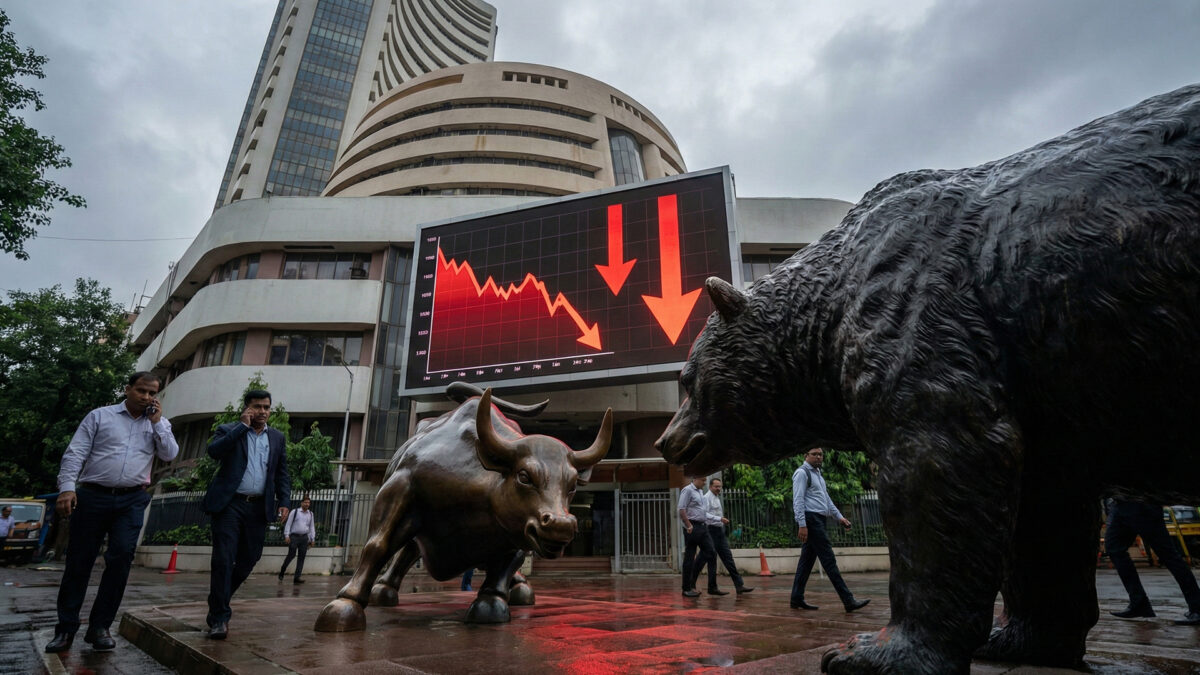
Markets traded volatile on Tuesday, January 13, 2026, as investors remained cautious amid mixed global cues and stock-specific action. The Sensex swung between gains and losses, while the Nifty 50 hovered near the 25,800 mark for most of the session.

After opening on a positive note, benchmark indices erased early gains due to selling pressure in IT and FMCG stocks. At the day’s low, the Sensex slipped over 200 points, while the Nifty briefly dipped below 25,750 before recovering partially.

Metal and energy stocks provided some support, helping limit deeper losses. Market participants remained selective ahead of key earnings announcements and continued to track global market trends.

Among the top gainers, Coal India, Hindalco Industries and Tata Steel rose on strong buying interest. Asian Paints and Trent also ended higher, supported by steady demand.

On the other hand, Eicher Motors, Titan Company and Bharat Electronics were among the major losers. Stocks such as Tata Motors Passenger Vehicles and Eternal also traded lower, dragged by profit-booking and weak sentiment in select sectors.

In the broader market, mid-cap and small-cap stocks showed mixed performance, with advances and declines evenly matched. Sectorally, metal and energy indices outperformed, while IT and FMCG indices underperformed.

Also Read: Sensex gains 302 points, Nifty crosses 25,750

Categories
Corporate

Sensex gains 302 points, Nifty crosses 25,750

Indian equity markets closed higher on Monday, as the BSE Sensex settled 302 points higher, while the NSE Nifty50 ended above the 25,750 mark, supported by late buying in metal and select consumer stocks.

Markets opened on a weak note and remained under pressure for most of the day. The Sensex had fallen over 700 points during intraday trade, and the Nifty slipped below 25,500, as investors stayed cautious amid mixed global cues and ongoing earnings announcements. However, sentiment improved sharply in the second half, helping benchmarks recover most of their losses by the close.

At the end of the session, the Sensex closed near 83,878, while the Nifty finished around 25,790. The rebound was driven largely by strength in metal stocks, which saw strong buying interest after recent corrections.

Among the top gainers, Coal India surged over 3 percent, emerging as the best-performing Nifty stock. Tata Steel and Asian Paints also gained nearly 3 percent each, supported by buying in commodities and expectations of stable demand. Other metal stocks such as JSW Steel and Hindalco Industries also ended higher, lifting the broader sector.

On the downside, IT and auto stocks faced selling pressure. Infosys slipped over 1 percent, reflecting continued caution around global technology spending. Tata Motors Passenger Vehicles, Bajaj Finance, Bajaj Auto, and Eicher Motors also ended lower, limiting the overall market upside.

Sectorally, metal and select consumer stocks outperformed, while IT, banking, and auto sectors showed mixed trends. Investors continued to assess quarterly earnings, including results from major IT companies, which remained a key focus during the session.

Global cues were mixed, with Asian markets trading unevenly and investors tracking developments related to international trade and macroeconomic data. The Indian rupee remained largely stable against the US dollar, offering little directional cue to equities.

Also Read: TCS Q3 steady as AI, IT spend rise

Categories
Corporate

TCS Q3 steady as AI, IT spend rise

Tata Consultancy Services (TCS), India’s largest IT services exporter, is expected to post a steady performance for the third quarter ended December 2025, with analysts forecasting modest growth in both revenue and profit. The slow growth reflects typical seasonal softness at year-end, cautious IT spending by clients, and global economic uncertainties.

According to estimates from brokerage firms, TCS’s dollar revenue is expected to increase only around 0.3% sequentially to $7.49 billion. In Indian rupee terms, revenue may rise about 1.4% to ₹66,715 crore, while net profit is seen growing roughly 1% to ₹13,035 crore. Operating margins could improve slightly due to favorable currency movements, even as fluctuations in the British pound, euro, and rupee against the dollar add some volatility to reported results.

While headline numbers are likely to be modest, investors are paying closer attention to TCS’s commentary on broader trends, particularly corporate IT spending and artificial intelligence (AI) adoption. With many companies prioritizing AI-led transformation projects, management insights on 2026 IT budgets and the strength of TCS’s order pipeline will be key indicators of future growth.

Peer companies such as HCL Technologies are also expected to show modest sequential revenue growth, supported by gains in their products and platforms segments. Analysts note that execution on AI solutions and gaining more share in existing clients’ IT budgets could become critical growth drivers for Indian IT firms, especially in a cautious spending environment.

Overall, TCS’s Q3 performance may appear steady rather than spectacular. However, the real focus for investors will be on the company’s strategic direction, AI initiatives, and the outlook for client spending, which together could set the tone for growth in the coming quarters.

Also Read: SBI revises ATM charges for savings, salary accounts

Categories
Corporate

SBI revises ATM charges for savings, salary accounts

State Bank of India (SBI) has revised its ATM charges, impacting savings and salary account holders. The new fee structure, effective from December 1, 2025, primarily affects withdrawals and transactions at non‑SBI ATMs. The revision comes after an increase in interbank charges, the fees banks pay each other for ATM usage.

For regular savings account holders, the first five financial and non-financial transactions at non‑SBI ATMs remain free. Beyond this, cash withdrawals will attract ₹23 plus GST, up from ₹21, while non-financial transactions, such as balance inquiries or mini statements, will cost ₹11 plus GST, up from ₹10.

Salary account holders, who previously enjoyed unlimited free transactions, will now get 10 free transactions per month at all ATMs. Post-limit transactions will be charged the same rates as above.

Basic Savings Bank Deposit (BSBD) account holders will see no changes in ATM charges. Similarly, SBI debit cardholders using SBI ATMs and cardless cash withdrawals will continue to enjoy free and unlimited transactions.

SBI has advised customers to monitor their ATM usage carefully to avoid unexpected charges. The fee revision reflects rising costs in ATM operations and interbank transactions, aiming to balance service sustainability while encouraging responsible usage.

Also Read: FPIs sell ₹3,963 cr in Indian stocks

Categories
Corporate

IndiGo races to hire pilots before DGCA deadline

India’s largest airline, IndiGo, is racing against time to hire more pilots and crew members to meet new safety rules set by the aviation regulator, the Directorate General of Civil Aviation (DGCA). The airline must comply with these rules by February 10, failing which it could face operational restrictions.

The new DGCA norms focus on Flight Duty Time Limitations (FDTL). These rules reduce how long pilots can work and increase mandatory rest periods. The aim is to improve safety and reduce pilot fatigue. However, these changes mean airlines now need more pilots to operate the same number of flights.

To meet the requirement, IndiGo has launched an aggressive hiring drive. It is offering attractive incentives to experienced pilots from other airlines. These include joining bonuses of up to ₹50 lakh, preferred home base postings, and assured flying hours during the initial months. In some cases, long-term contracts may carry benefits worth up to ₹1.25 crore if pilots stay with the airline for a fixed period.

IndiGo has also introduced referral bonuses for its existing staff. Employees who recommend pilots that successfully join the airline before the deadline can earn between ₹50,000 and ₹75,000 per referral. The airline plans to induct around 100 pilots in January alone to strengthen its workforce.

Apart from hiring, IndiGo has increased several pilot allowances from January 1. These include higher payments for night flying, domestic layovers, deadhead duties, and a newly introduced allowance for aircraft tail swaps. Under the revised structure, captains will earn ₹2,000 per hour for night flying, while first officers will get ₹1,000 per hour.

Despite having a pilot strength of over 5,000, IndiGo says the new rules require additional manpower to ensure smooth operations without flight cancellations or delays. The DGCA has provided limited and temporary relief by allowing some flexibility in night-duty rules until February 10. However, this comes with strict conditions, including regular reporting on crew deployment and scheduling practices.

Also Read: Adani plans ₹1.5 lakh cr investment in Kutch

Categories
Corporate

Adani plans ₹1.5 lakh cr investment in Kutch

Shares of Adani Ports and Special Economic Zone (APSEZ) drew attention in the stock market after the Adani Group announced a major investment plan for Kutch in Gujarat. The group plans to invest ₹1.5 lakh crore over the next five years, focusing on ports, renewable energy and related infrastructure.

The announcement was made by Karan Adani, Managing Director of Adani Ports, at the Vibrant Gujarat Regional Conference held in Rajkot. He said the investment reflects the group’s long-term confidence in Gujarat and its growing importance in India’s economic development.

A key part of the plan is the expansion of Mundra Port, India’s largest commercial port located in Kutch. According to Adani, the company aims to double the port’s cargo handling capacity over the next 10 years. This expansion is expected to strengthen India’s trade and logistics network and support higher exports and imports.

Another major focus area is renewable energy. The Adani Group plans to fully develop the Khavda renewable energy project, which has a planned capacity of 37 gigawatts (GW). Once completed by 2030, it is expected to be one of the world’s largest renewable energy projects, contributing significantly to India’s clean energy goals.

Karan Adani highlighted that Kutch, which was once considered a remote region, has now become an important hub for ports, power and industrial activity. He said large investments in infrastructure have transformed the region and created new opportunities for businesses and local communities.

The announcement also underlined Gujarat’s strong role in the national economy. The state contributes over 8% to India’s GDP and handles more than 40% of the country’s total port cargo, making it a key driver of growth.

Following the news, Adani Ports shares remained in focus as investors assessed the long-term benefits of the investment plan. Market participants believe the proposed spending could support future growth, improve capacity and strengthen the company’s leadership in the ports and logistics sector.

Also Read: Gold jumps ₹2,000, silver soars ₹10,000 to record highs

Categories
Corporate

Sensex tumbles 400 points, Nifty drops below 25,600

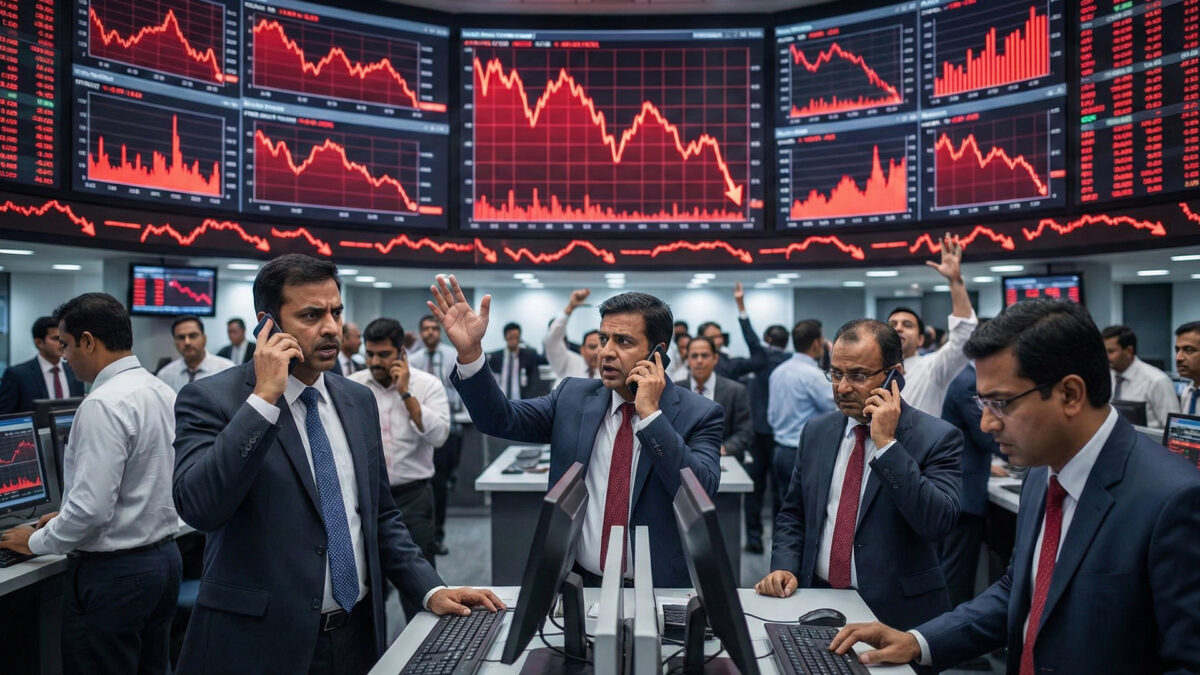
Indian equity benchmarks extended their losing streak on Monday, BSE Sensex declined by over 400 points, while the NSE Nifty 50 slipped below the 25,600 mark, as selling pressure dominated most sectors.

The market opened lower and remained under pressure through early trade, tracking mixed trends in Asian markets and cautious signals from U.S. stock futures. Investor sentiment remained subdued amid concerns over global economic growth, interest rate uncertainty, and geopolitical risks, prompting risk-averse positioning.

Market volatility increased sharply, with the India VIX moving higher, reflecting growing nervousness among traders. Sector-wise, banking, real estate, auto and consumer discretionary stocks led the decline, dragging the broader indices lower. IT stocks also traded mixed as investors weighed demand outlook and currency movements.

Among individual stocks, Ola Electric emerged as a major loser, falling around 4% after reports of a stake sale by a key investor dampened sentiment. Tejas Networks plunged sharply after posting weak quarterly results marked by a steep fall in revenue and widening losses. Signatureglobal also remained under pressure, sliding closer to its 52-week low amid concerns over growth guidance.

On the other hand, a few stocks managed to buck the weak market trend. IREDA shares gained after the state-owned lender reported a strong rise in quarterly profit and revenue, supported by higher loan disbursements. Avenue Supermarts, the parent company of DMart, advanced after reporting better-than-expected earnings, offering some support on an otherwise weak trading day.

In the broader market, mid-cap and small-cap stocks also faced selling pressure, with declines outnumbering advances, indicating widespread weakness.

In currency markets, the rupee traded lower against the US dollar, reflecting continued foreign institutional investor ouniftytflows and global risk-off sentiment.

Also Read: SEBI eases tech glitch rules for brokers

Categories
Corporate

Mukesh Ambani’s Jio eyes 2.5% IPO in 2026

Mukesh Ambani-led Reliance Jio Platforms is preparing for an initial public offering (IPO) in 2026 that could become the largest in India’s history. The company is considering selling a 2.5 per cent stake, potentially raising over $4 billion (around ₹33,000 crore) if valuations hold.

The IPO is among the most anticipated in the Indian market, reflecting Jio’s rapid growth since its launch and its expansion into telecommunications, digital services, and AI. With more than 500 million subscribers, Jio is India’s biggest mobile network operator.

Valuation talks are ongoing. Investment bank Jefferies estimated Jio Platforms’ value at roughly $180 billion late last year. At that level, a 2.5 per cent stake could fetch about $4.5 billion, surpassing previous record IPOs in India. Some bankers have suggested even higher valuations, up to $200–240 billion, but final decisions on pricing and structure are yet to be made.

A key factor in the plan is a pending regulatory change that would reduce the minimum public float requirement for large IPOs from 5 per cent to 2.5 per cent. This would allow Jio to sell a smaller portion initially, generating higher investor interest and pricing tension.

Reliance executives have not publicly commented on the IPO. It remains unclear whether the offering will involve new shares, an offer-for-sale by existing shareholders, or a combination of both. Morgan Stanley and Kotak have been engaged to prepare the IPO prospectus, a regulatory requirement for listing.

If completed, the listing would energize India’s IPO market, which ranked among the world’s top markets in 2025. Jio’s entry could set a new benchmark for technology and telecom valuations in India and provide an exit for early investors who backed the company during its rapid growth phase.

The IPO would also highlight Mukesh Ambani’s strategy to unlock value from Reliance Jio Platforms while maintaining strong control over the company’s long-term vision.

Also Read: US lets India buy Venezuelan oil

Categories
Corporate

IEX stock falls after APTEL defers market coupling case

Shares of Indian Energy Exchange (IEX) declined on Friday as investors reacted to continued uncertainty over proposed reforms in the power trading market. The fall came after the Electricity Appellate Tribunal (APTEL) adjourned the hearing on the market coupling issue to January 19, 2026, extending the wait for regulatory clarity.

The case relates to a challenge filed by IEX against directions issued by the Central Electricity Regulatory Commission (CERC) in July 2025. These directions propose the introduction of market coupling, a mechanism aimed at creating a single, unified price for electricity by pooling bids from all power exchanges. The reform is intended to improve efficiency and transparency in price discovery across the power market.

IEX has opposed the move, arguing that the proposed system could adversely impact competition and undermine its business model. The company has also raised concerns about the process followed by the regulator, stating that it was not given adequate opportunity to present its views before the directive was issued.

During the latest hearing, CERC informed the tribunal that the July communication should be treated as a direction and not a final, binding order. The regulator’s counsel sought additional time to clarify whether the directive could be modified or withdrawn, given the questions raised by the tribunal. Taking note of these submissions, APTEL decided to defer the matter and asked both sides to file further documents before the next hearing.

The tribunal also flagged the need for greater transparency and procedural fairness in regulatory decision-making, indicating that these aspects would be examined in detail when the case resumes.

The postponement led to sharp volatility in IEX shares. The stock moved sharply during the session and slipped as much as nearly 8 per cent at one point, as traders and investors reacted to the absence of a clear timeline on the implementation of market coupling.

Market analysts say the issue is significant for IEX, which currently dominates trading volumes in the day-ahead power market. If market coupling is implemented, price discovery would shift to a centralised mechanism, potentially reducing the influence of individual exchanges and altering competitive dynamics in the sector.

Also Read: BCCL ₹1,071 cr IPO sees strong demand

Categories
Corporate

Amagi Media Labs IPO opens January 13

Amagi Media Labs, a Bengaluru-based cloud software and media technology company, will open its initial public offering (IPO) for public subscription on January 13, 2026. The issue will close on January 16, with anchor investor bidding scheduled a day earlier on January 12.

The IPO is a book-built issue worth about ₹1,788 crore, consisting of a fresh issue of shares worth ₹816 crore and an Offer for Sale (OFS) of ₹972 crore by existing shareholders, including Accel, Norwest Venture Partners and PI Opportunities Fund. At the upper end of the price band, the company is valued at over ₹7,800 crore.

Amagi has fixed the price band at ₹343 to ₹361 per share. Retail investors can apply for a minimum lot of 41 shares, requiring an investment of around ₹14,800 at the cut-off price. The allotment of shares is expected on January 19, while the company is likely to list on the NSE and BSE on January 21.

Founded in 2008, Amagi Media Labs operates as a software-as-a-service (SaaS) company, offering cloud-based solutions that help media companies and content owners manage, distribute and monetise video content. Its platforms are widely used in the fast-growing connected TV (CTV) and digital advertising space, enabling targeted ad placements across smart TVs, mobile devices and streaming apps.

The company plans to use proceeds from the fresh issue to strengthen its technology and cloud infrastructure, pursue strategic acquisitions, and meet general corporate needs.

The IPO allocation structure reserves 75 per cent for qualified institutional buyers, 15 per cent for non-institutional investors, and 10 per cent for retail investors. Early market indicators suggest healthy interest ahead of the issue, reflecting investor appetite for technology-driven and digital media-focused businesses entering the public markets.

Also Read: Nestlé India confirms local formula safe for consumers