
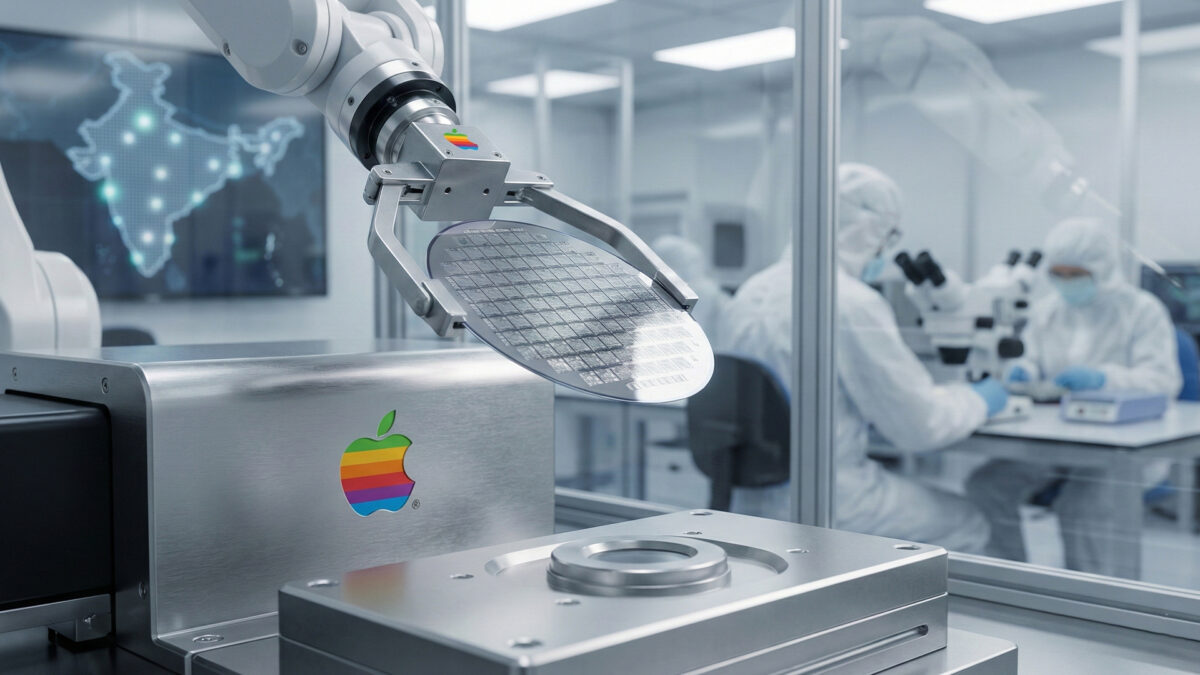
Apple is taking a closer look at India’s semiconductor ecosystem as it explores the possibility of assembling and packaging select iPhone components locally, marking a potential shift in how deeply the company integrates India into its global supply chain.
According to reports, Apple has initiated early-stage discussions with Indian chipmakers, including CG Semi, a Murugappa Group company that is setting up an outsourced semiconductor assembly and test (OSAT) facility in Sanand, Gujarat. The focus of these talks is on backend chip processes such as assembly, testing and packaging — a critical but less complex stage compared to advanced chip fabrication.
If the plans move forward, this would be the first time Apple brings chip-level work for iPhones into India. Currently, India’s role in Apple’s manufacturing network is largely limited to final device assembly through partners like Foxconn, Tata Electronics and Pegatron. Adding semiconductor packaging would significantly raise India’s value contribution in the iPhone production chain.
Industry sources indicate that the discussions are still exploratory. Any partnership would require Indian suppliers to meet Apple’s strict benchmarks on quality, yield, reliability and scale. Neither Apple nor CG Semi has officially confirmed the talks.
From a technology and supply-chain perspective, the move fits squarely into Apple’s broader diversification strategy. The company has been steadily reducing dependence on China by expanding manufacturing in alternative locations, particularly India and Vietnam. Rising geopolitical risks, trade barriers and supply disruptions have accelerated this shift across the global tech industry.
India, meanwhile, is positioning itself as a semiconductor hub under government-backed incentive schemes aimed at attracting chip assembly, testing and fabrication investments. OSAT facilities are seen as a practical entry point, requiring lower capital and shorter timelines compared to full-scale chip fabs.
Apple’s interest could act as a catalyst for India’s semiconductor ambitions. Securing a global technology leader as a customer would not only validate local capabilities but also encourage further investments in chip design, materials and advanced packaging technologies.
While India is still years away from competing with established semiconductor hubs in Taiwan or South Korea, analysts say incremental steps like chip packaging for iPhones could steadily build expertise and confidence.
For Apple, deeper localisation offers greater supply-chain resilience. For India, it represents a meaningful step up the global technology value chain, from assembling devices to handling core components that power them.
Also Read: US Tech Force set to boost AI and digital services