
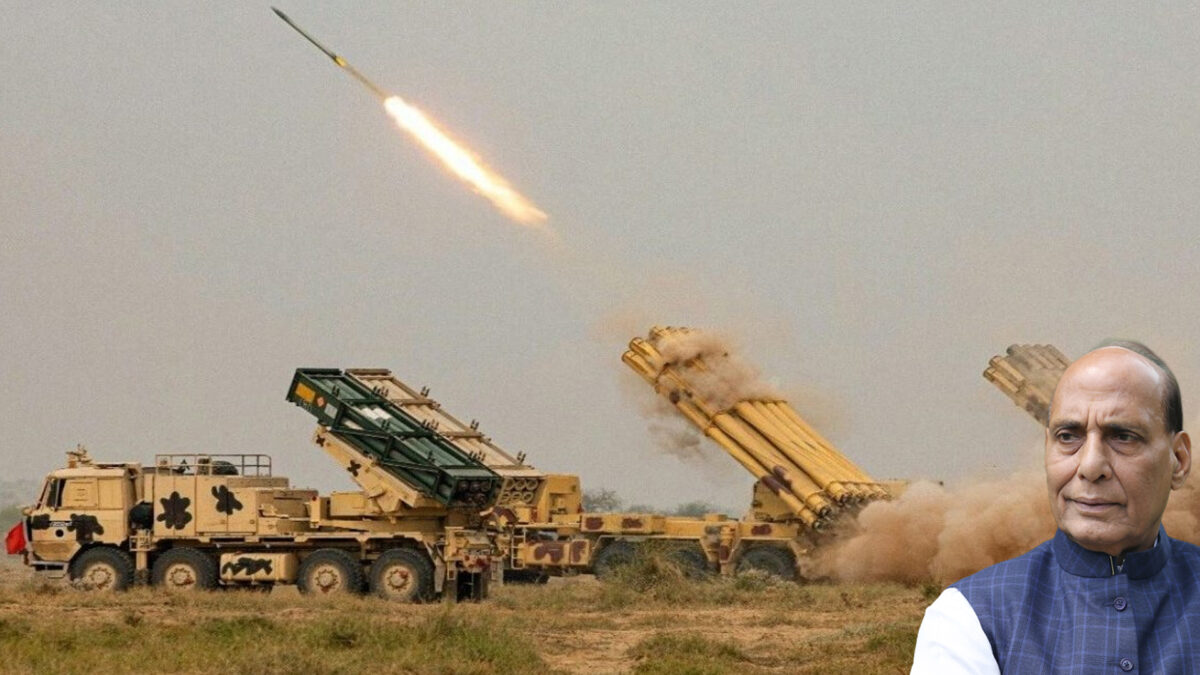
The Defence Acquisition Council (DAC), headed by Defence Minister Rajnath Singh, has cleared proposals worth Rs 79,000 crore for modernising India’s military forces. The approvals, given on December 29, 2025, cover a wide range of advanced equipment for the Army, Navy, and Air Force, boosting precision strike, surveillance, air defence, and counter‑drone capabilities.
For the Indian Army, key procurements include loiter munition systems to conduct targeted strikes, low‑level lightweight radars to detect small drones, long-range guided rockets for the Pinaka missile system, and the Integrated Drone Detection & Interdiction System Mk‑II to secure strategic areas.
The Indian Air Force will receive Astra Mk‑II beyond‑visual-range air-to-air missiles with extended reach, SPICE‑1000 precision guidance kits, as well as full mission simulators and automatic take-off and landing recording systems to enhance pilot training and safety.
The Indian Navy will benefit from bollard pull tugs for port operations, high-frequency software-defined manpack radios for secure communication, and lease extensions for high-altitude long-endurance drones to maintain maritime surveillance.
While the DAC’s Acceptance of Necessity (AoN) approval marks the first step in procurement, final contracts will follow detailed negotiations. These acquisitions are part of India’s broader defence modernisation drive, aimed at strengthening operational readiness and technological edge amid evolving regional security challenges.
Defence analysts say the move demonstrates India’s intent to equip its forces with state-of-the-art technology, reduce dependence on imports over time, and enhance both offensive and defensive capabilities across land, air, and sea domains.
The Rs 79,000 crore package reflects the government’s push for a balanced mix of indigenous and imported systems, ensuring quicker deployment and strategic flexibility. This marks one of the largest single approvals for defence hardware in recent years, underlining the country’s commitment to modernising its armed forces and addressing emerging threats efficiently.
Also Read: Geoffrey Hinton warns 2026 could trigger major AI job shock