
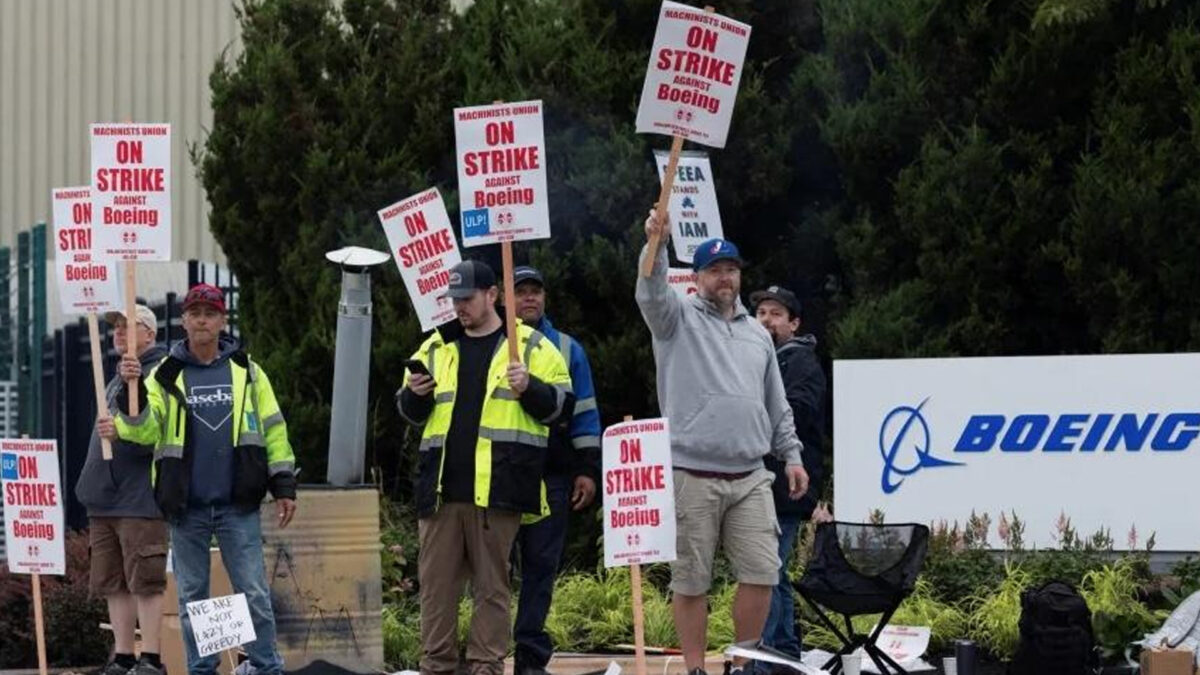
Boeing’s defense workers in the St. Louis area have voted to continue their strike after rejecting the company’s latest contract proposal.
The vote, held on October 26, resulted in a narrow 51% to 49% decision against the five-year offer, marking the fourth time union members have turned down Boeing’s contracts since the strike began on August 4.
Approximately 3,200 members of the International Association of Machinists and Aerospace Workers (IAM) District 837, representing Boeing’s defense facilities in St. Louis, St. Charles, and Mascoutah, Illinois, are involved in the strike.
The union has criticized Boeing for offering terms they consider inadequate compared to agreements reached with commercial division workers in Seattle, who received a 38% wage increase and a $12,000 signing bonus last year.
The rejected contract included a 24% wage increase over five years, a $3,000 stock incentive, and a $1,000 retention bonus.
Union leaders contend that the offer fails to sufficiently address their demands for improved retirement benefits and bonuses comparable to those granted to commercial aircraft employees.
The strike has disrupted Boeing’s production of military aircraft, including the F-15EX and F/A-18 Super Hornet jets.
The U.S. Air Force has reported delays in aircraft deliveries, affecting operations at bases such as the Portland Air National Guard Base in Oregon.
Boeing has implemented contingency plans to mitigate production disruptions but has warned that the strike is financially harmful to workers and stated that no further increases in the contract’s overall value will be offered.
As the strike enters its 13th week, both sides remain at an impasse, with no immediate resolution in sight.
The union has filed an unfair labor practice charge against Boeing, alleging bad faith in negotiations.
The ongoing labor dispute highlights growing tensions between Boeing and its defense workforce, with potential implications for the company’s military operations and broader relations with aerospace labor unions.
Analysts suggest that the outcome of this strike could influence future contract negotiations and set a precedent for labor-management interactions in the sector.
Also Read: Novartis To Acquire Avidity Biosciences In US$12 Billion Deal