
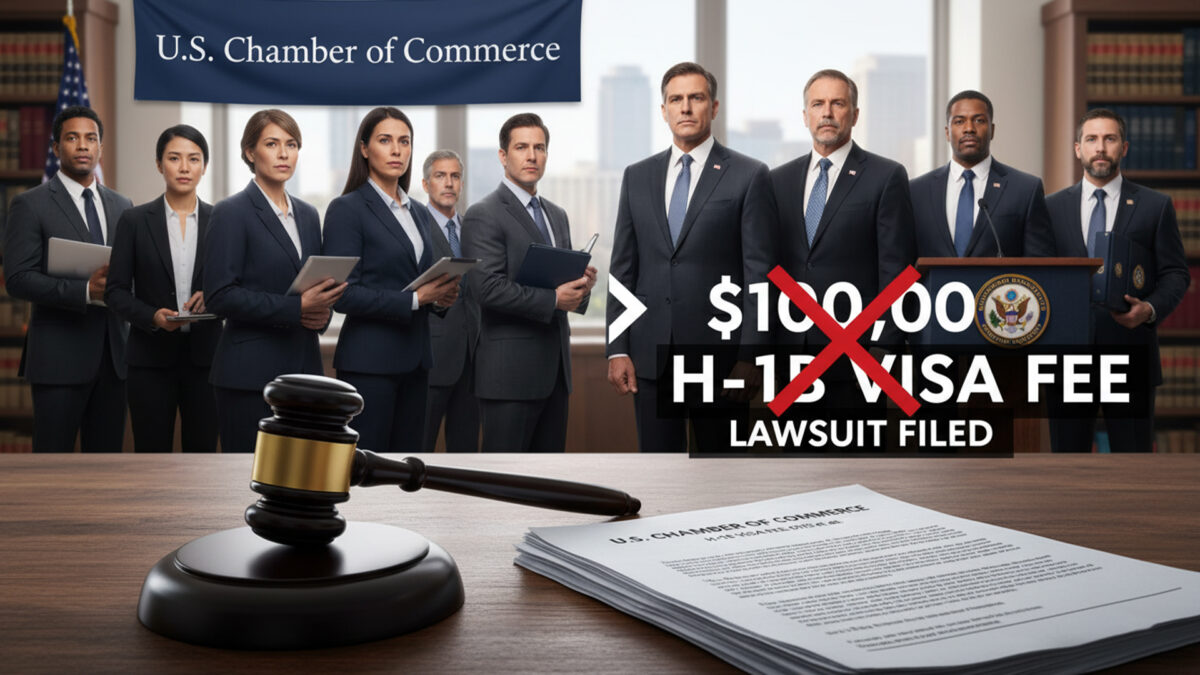
The U.S. Chamber of Commerce has filed a lawsuit against the Trump administration, challenging its decision to impose a $100,000 annual fee on new H-1B visa petitions.
The powerful business group argues that the measure exceeds the president’s legal authority, violates the Immigration and Nationality Act, and threatens the ability of U.S. companies to attract and retain high-skilled foreign workers essential to their operations.
The lawsuit, filed in the U.S. District Court for the District of Columbia, names several federal agencies and officials, including the Department of Homeland Security and the Department of State, as defendants.
The Chamber is seeking an injunction to block enforcement of the policy and a ruling declaring the fee unlawful.
The petition contends that under U.S. immigration law, visa fees must reflect the actual administrative costs of processing applications — something the new $100,000 charge far exceeds.
The controversial fee, announced in September, applies to new H-1B visa petitions filed between September 21, 2025, and September 21, 2026. Existing visa holders and renewals are exempt.
The administration defended the move as a measure to protect American workers, claiming that the high fee would discourage what it described as “overuse” of the H-1B system by large technology and outsourcing firms. Employers could, however, apply for a national interest waiver under certain conditions.
The Chamber of Commerce, which represents millions of businesses across industries, countered that the policy would have devastating effects on the U.S. economy, particularly in sectors that depend heavily on foreign talent, such as information technology, healthcare, and engineering.
The group said the surcharge is so excessive that it effectively acts as a barrier to hiring, forcing companies to either reduce recruitment or shift operations overseas.
Industry leaders and economists have echoed these concerns, warning that such a drastic increase in fees could damage America’s competitiveness in the global talent market.
The H-1B program, which allows U.S. companies to hire foreign professionals in specialized fields, has long been viewed as critical to innovation and growth in areas such as artificial intelligence, biotechnology, and semiconductor research.
The legal challenge marks one of the first major confrontations between the Chamber of Commerce and the Trump administration during its second term.
The group has traditionally supported pro-business policies but has clashed with the White House over trade and immigration matters in the past.
Analysts say this lawsuit underscores growing tensions between corporate America’s labor needs and the administration’s protectionist approach to immigration.
Legal experts believe the case could set an important precedent. Courts will likely examine whether the executive branch has the authority to impose such a steep fee without explicit approval from Congress.
If the Chamber’s arguments prevail, the ruling could limit presidential power to unilaterally reshape key aspects of immigration policy.
For now, the business community is closely watching the case, with many companies delaying hiring plans that depend on H-1B visas until the issue is resolved.
The outcome will not only determine the future of the $100,000 fee but may also influence the broader balance between executive discretion and legislative oversight in U.S. immigration law.
Also Read: Zepto Set to Lock $500M Round, Eyes Valuation Above US$7B and IPO