
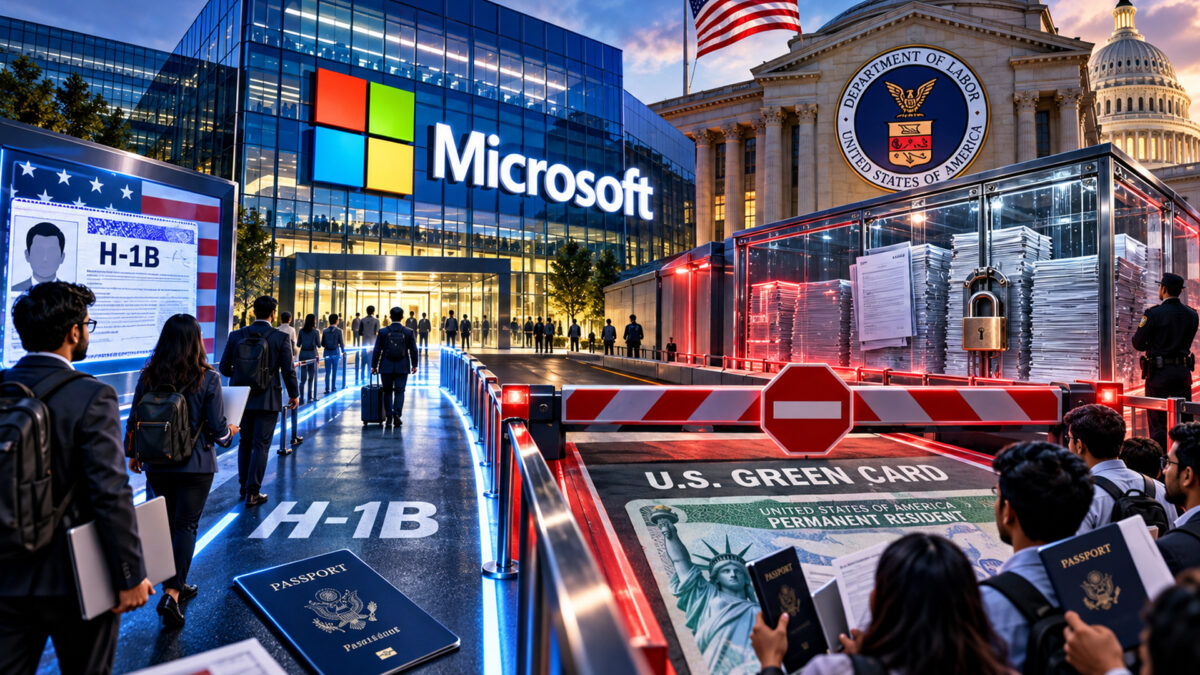
The United States has suspended Microsoft and seven other major technology companies from a key employment-based green card programme, intensifying the Trump administration’s crackdown on skilled foreign workers. Vice President JD Vance announced the move on October 8, accusing companies of exploiting immigration rules while American employees face layoffs. The decision could affect thousands of foreign professionals, including Indian technology workers hoping to secure permanent residency in the US.
The restrictions target the Permanent Labour Certification programme, known as PERM, which is a crucial step in the employment-based green card process. The US Department of Labour said it would neither accept new applications nor process pending applications involving the affected companies. Officials said the suspensions would remain in place while investigations into alleged misuse of the system continue.
The eight companies named are Microsoft, Adobe, Cognizant, Infosys, Tata Consultancy Services (TCS), Wipro, HCL Technologies and Capgemini. The move brings major technology firms and IT services providers under increased scrutiny as Washington seeks to prioritise American workers in recruitment and hiring.
Vance singled out Microsoft, alleging that the company had laid off around 6,000 American workers in the previous year while benefiting from approximately 6,300 H-1B visa approvals and nearly 3,000 green cards. He argued that the figures raised questions about whether employers were using foreign-worker programmes to replace domestic employees.
However, the administration did not publicly establish that the layoffs were directly linked to the hiring of foreign workers. Microsoft has also disputed the suggestion that its immigration practices undermine American employees.
The company said most of its H-1B filings in the last fiscal year were intended to extend or change the status of existing employees rather than recruit new workers. Microsoft added that it follows the requirements of the visa category and pays H-1B employees the same as other employees performing comparable work. It has also maintained that its workforce strategy combines domestic hiring with attracting skilled talent from around the world.
The distinction between H-1B visas and PERM is important. The H-1B programme allows US employers to hire foreign professionals for specialised occupations, including software engineering, technology research and other skilled roles. PERM, on the other hand, is a labour certification process that employers generally need to complete before sponsoring eligible workers for employment-based green cards.
Under PERM rules, employers must demonstrate that qualified American workers are not available for the position and that hiring a foreign employee will not adversely affect the wages and working conditions of similarly employed US workers.
The latest decision does not automatically cancel existing H-1B visas or prevent affected companies from employing workers who already hold them. Instead, it blocks a key route through which eligible employees can move towards permanent residency. Workers may consequently have to remain on temporary visas for longer, while employers could find it harder to attract international professionals who view a green card pathway as an important part of their long-term career plans.
The implications are particularly significant for Indian professionals, who make up a substantial share of H-1B visa holders and form a major part of the US technology workforce. Indian IT companies have long relied on skilled employees to deliver services to American clients, although industry representatives have said companies have reduced their dependence on H-1B visas in recent years.
According to figures cited by US officials, the affected companies had sought nearly three million foreign workers since 2009 and received more than 230,000 H-1B visa approvals and over 100,000 permanent labour certifications. The government has not suggested that every application or visa issued to these companies involved wrongdoing.
The announcement also comes amid wider immigration restrictions under President Donald Trump. The administration has pursued tougher measures affecting skilled foreign workers, including a proposed $103,000 fee on certain new H-1B petitions. These policies have triggered debate over whether tighter controls will protect American workers or make it more difficult for US businesses to recruit specialised talent.
Critics argue that restricting access to permanent residency could make foreign professionals more dependent on their employers and discourage highly skilled workers from choosing the US. Supporters of the crackdown maintain that employers must demonstrate genuine labour shortages before turning to overseas recruitment.
The administration has also announced investigations into nine universities over alleged misuse of the J-1 exchange visitor visa programme. The institutions include Harvard, Yale, Stanford, Brown, the Massachusetts Institute of Technology, the University of California, Davis, the University of Pittsburgh, Arizona State University and the California Institute of Technology. Officials said the investigations would examine possible visa violations, foreign influence and issues involving federally funded research.
The action against technology companies marks a significant escalation in Washington’s scrutiny of employment-based immigration. Although the H-1B programme remains operational, the suspension of PERM applications creates fresh uncertainty for foreign professionals seeking permanent residency. The outcome of the investigations and any subsequent changes to the restrictions will determine how deeply the decision affects employers, Indian IT workers and the wider US technology sector..