
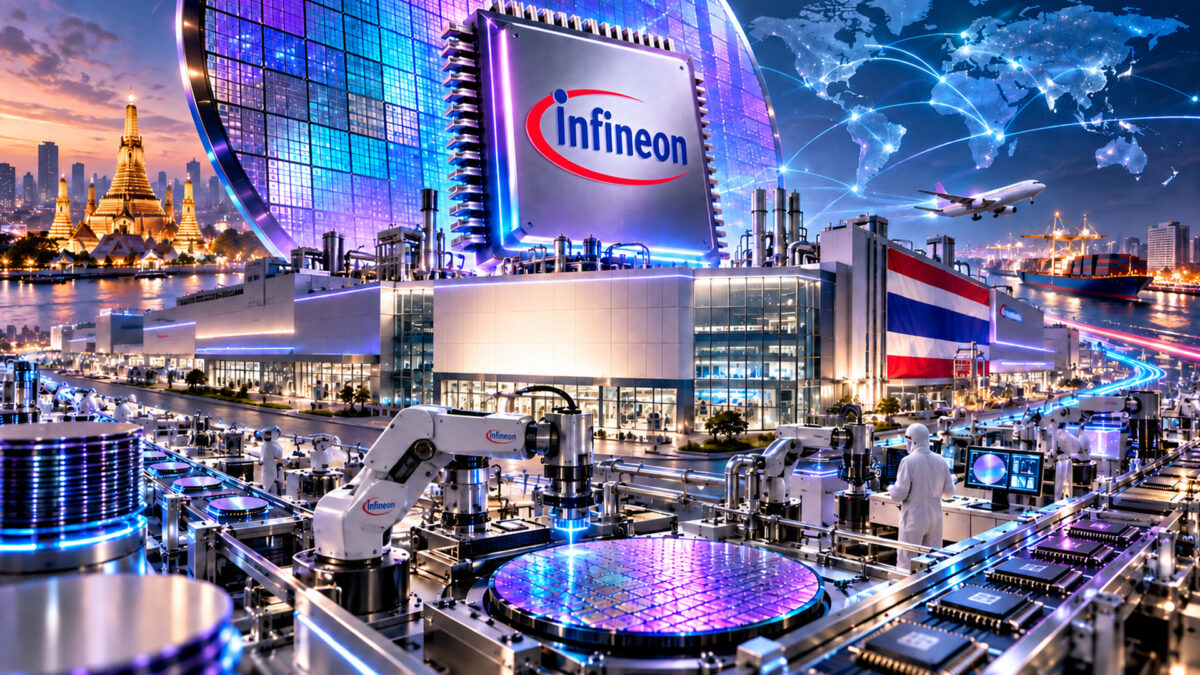
German semiconductor maker Infineon Technologies has opened a new manufacturing facility in Thailand, deepening its presence in Southeast Asia and supporting the country’s ambition to become a more important player in the global semiconductor industry.
The new site in Samut Prakan, near Bangkok, is a backend semiconductor manufacturing facility, where chips undergo assembly, packaging and testing before reaching customers. Infineon said the investment will strengthen and diversify its global production network at a time when demand for semiconductors is being driven by digitalisation, electrification and the energy transition.
The broader investment in Thailand is valued at around 48 billion baht, or about $1.4 billion. The initial phase involves more than €100 million, or roughly $114 million, in investment. The first module has up to 30,000 square metres of cleanroom space, with the site designed to eventually expand to as much as 150,000 square metres.
Infineon Chief Operations Officer Alexander Gorski said the company sees Thailand as a strategic, long-term investment. The country’s location, logistics network, established electronics and semiconductor industries and access to major Asian markets were among the factors supporting the expansion.
The facility has been designed around a modular structure that can eventually accommodate five modules. This gives Infineon the flexibility to increase production capacity as demand develops. The company said Bangkok could eventually become one of its largest backend manufacturing locations worldwide.
The plant currently employs about 350 people, with the workforce expected to increase to around 1,000 highly skilled employees as the first module ramps up. Infineon is also working with universities, educational institutions and industry partners to develop semiconductor skills in Thailand.
The investment comes as Thailand seeks to strengthen its position in the semiconductor supply chain. Southeast Asia has become increasingly important to global chipmakers as companies look to diversify production and reduce their dependence on concentrated manufacturing locations.
Thailand already has a sizeable electronics and automotive manufacturing base. Its semiconductor strategy is now focused on attracting higher-value investments and developing capabilities that can support industries such as electric vehicles, artificial intelligence, data centres, renewable energy and industrial automation.
Infineon’s new facility fits directly into those growth areas. The company specialises in power semiconductors, which are used to control and convert electrical energy efficiently. These chips are increasingly important in electric vehicles, charging infrastructure, renewable energy systems, industrial equipment and data-centre infrastructure.
The Bangkok site includes advanced cleanrooms, assembly and testing capabilities, wafer testing and a high level of automation. Infineon said its digital manufacturing systems are designed to support efficient production while allowing the facility to adapt to changing customer requirements and larger production volumes.
The company’s decision also reflects a wider shift in the global semiconductor industry. Demand for chips is growing alongside investment in artificial intelligence, cloud computing, electric mobility and energy infrastructure. At the same time, manufacturers are looking for geographically diversified supply chains that can provide greater flexibility and resilience.
Thailand’s location gives it an additional advantage. The country sits at the centre of Southeast Asia and has established trade and logistics connections with major manufacturing economies across the region. Its proximity to China and other Asian markets was also highlighted by Infineon as part of the rationale for the investment.
Infineon is also looking beyond the immediate backend operation. The company sees potential for Thailand to eventually play a role in broader semiconductor production, including wafer fabrication. However, Gorski indicated that such a move is unlikely within the next three years, meaning the immediate priority remains assembly, packaging, testing and related manufacturing capabilities.
That possibility could become significant for Thailand because wafer fabrication represents a more advanced stage of semiconductor manufacturing and requires substantially greater capital, infrastructure and technical expertise. For now, Infineon is concentrating on building the backend hub and developing the local ecosystem around it.
The investment is also expected to contribute to Thailand’s efforts to develop semiconductor talent. Infineon plans to work with local educational institutions, while the facility itself is expected to create skilled employment in engineering, manufacturing, automation and technology-related functions.
Sustainability has been incorporated into the new facility as well. Infineon said the Bangkok site operates on 100% green electricity, while water recycling, rainwater collection and onsite solar generation are part of its resource-efficiency measures.
The Thailand expansion for Infineon is therefore more than an additional factory. It adds a scalable manufacturing base to its global network while giving the company greater access to a fast-growing Asian market.
This investment provides another step towards building a deeper semiconductor ecosystem, moving beyond traditional electronics and automotive manufacturing into more specialised chip production and technology services.
With the Bangkok site capable of expanding through multiple modules, its eventual scale will depend on market demand and Infineon’s future investment decisions. For now, the opening establishes Thailand as a growing part of the company’s global semiconductor manufacturing network.