
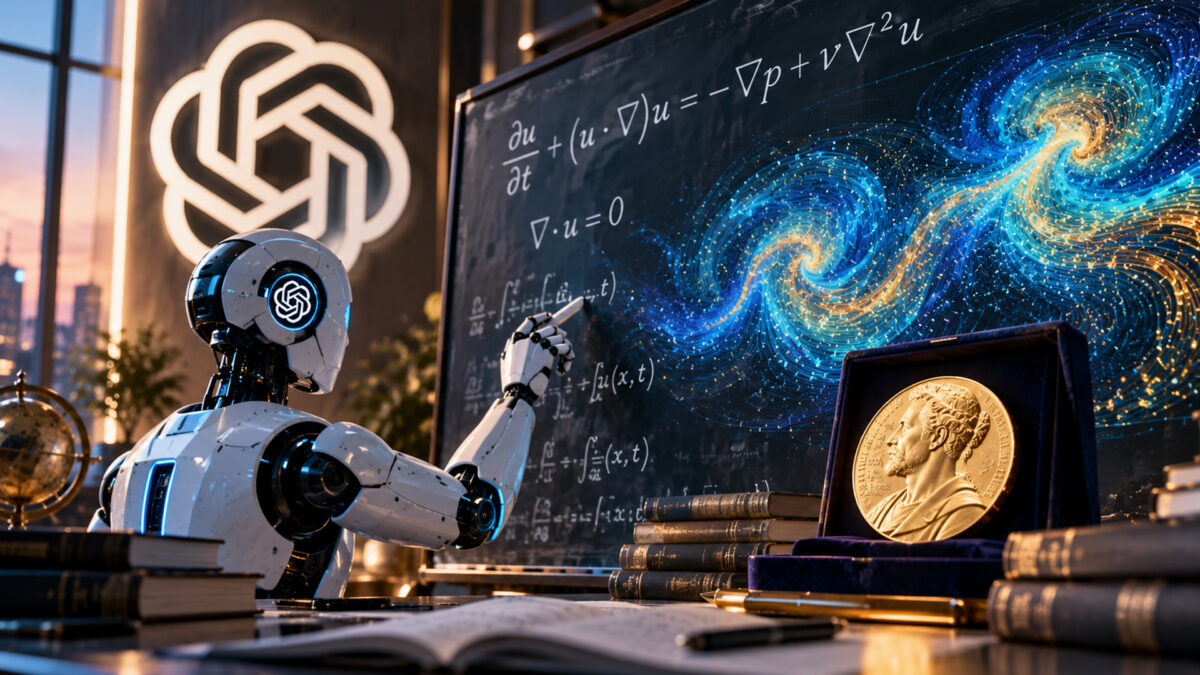
OpenAI has claimed a major breakthrough in mathematics, saying an artificial intelligence system has produced a solution to the nearly 90-year-old Navier-Stokes existence and smoothness problem, one of the most difficult unsolved questions in modern mathematics.
The claim has attracted global attention not only because of the complexity of the problem, but also because of the speed at which OpenAI says its AI systems reached the result. The company said it deployed around 10,000 AI agents, which worked on different mathematical approaches before producing a result in about 88 hours. The work was then formally checked using Lean, a computer-based proof verification system, in a process that took another 17 hours.
The development is being closely watched because the Navier-Stokes problem is one of the seven Millennium Prize Problems identified by the Clay Mathematics Institute. Each problem carries a $1 million prize for a correct solution. However, OpenAI has said it does not intend to claim the prize for its latest result.
At the heart of the problem are equations that describe how fluids such as water and air move. While these equations are widely used in science and engineering, mathematicians have struggled for decades with a deeper question: can a fluid that begins in a smooth and predictable state eventually develop a singularity where its velocity becomes unbounded in a finite amount of time?
That may sound highly theoretical, but the mathematics has practical importance. Navier-Stokes equations are central to areas including aerospace engineering, weather forecasting, ocean modelling and research into blood flow. A rigorous breakthrough could therefore have implications far beyond pure mathematics.
According to OpenAI, its internal AI system, which is more powerful than its publicly available GPT-6 Astra model, explored the problem through a large network of autonomous agents. Rather than asking one AI model to work through the problem from beginning to end, thousands of agents were able to investigate different formulations and possible routes simultaneously.
OpenAI said the agents exchanged nearly three million messages and generated about 130 billion output tokens during the effort. The company estimated that running such a large operation would have cost around $10 million, based on the pricing of its most advanced models.
The reported breakthrough, however, has not been without controversy.
New York University mathematician Tristan Buckmaster, who was working on related Navier-Stokes questions with Levent Alpöge, a mathematician associated with rival AI company Anthropic, has raised questions about the timing of OpenAI’s announcement.
Buckmaster and Alpöge had been using OpenAI’s Codex programming tool while working on their research. Buckmaster said he learned on September 3 that information about their progress had reached OpenAI. He questioned whether their work could have influenced the company’s decision to pursue the problem and how quickly its system subsequently produced a result.
OpenAI has rejected the suggestion that its researchers or AI agents accessed the pair’s unpublished work. The company said its researchers did not see their material before it was publicly released and that no specific user data was accessed to solve the problem.
At the same time, OpenAI acknowledged that it could not completely rule out the possibility that de-identified data from users’ interactions with its products may have contributed indirectly to model improvements. The company maintained that its mathematical proof was significantly different from the work being developed by Buckmaster and Alpöge.
That distinction has become an important part of the story. The question is no longer simply whether AI can solve difficult mathematics, but also how such discoveries should be credited when humans and AI systems work alongside one another.
OpenAI itself has acknowledged that increasingly capable AI systems are changing mathematical research. The company says the arguments in its latest work were generated by its AI system, while OpenAI researchers prepared the manuscripts and formalised the proofs in Lean. It has also called for the mathematical community to examine the findings closely and place them in the wider context of ongoing research.
The “claim” remains important as the result has not been independently accepted as a solution by the wider mathematical community, and the Clay Mathematics Institute has not awarded the associated prize.
Still, the development marks another striking moment in the rapidly changing relationship between artificial intelligence and mathematics. If the proof survives independent scrutiny, it could show that AI systems are moving beyond assisting mathematicians with calculations and are beginning to contribute to problems that have resisted human efforts for generations.
The bigger question may be what comes next. If thousands of AI agents can explore mathematical ideas around the clock, problems that once required decades of human effort could increasingly be approached at machine speed. The OpenAI breakthrough, whether ultimately confirmed in full or revised, has already opened that conversation.