
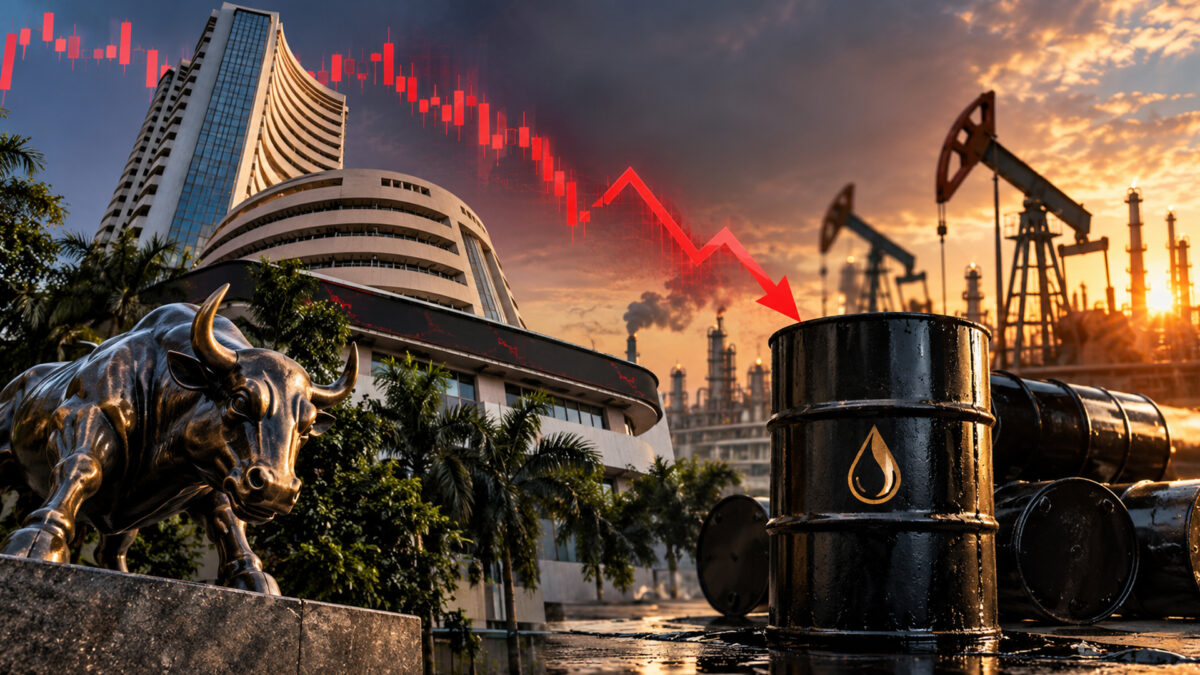
Indian benchmark indices ended sharply lower on Tuesday, as rising crude oil prices and renewed tensions in the Middle East made investors more cautious. The Sensex slipped 555.23 points, or 0.73%, to close at 75,577.58, while the Nifty 50 fell 144.05 points, or 0.61%, to settle at 23,635.10.
The sell-off gathered pace during the session as concerns over expensive oil weighed on sentiment. With Brent crude moving closer to the psychologically important $100-a-barrel mark, investors worried about the possible impact on India’s import bill, inflation and the rupee.
Banking stocks were among the biggest drags on the benchmarks. ICICI Bank, Axis Bank, SBI Life Insurance, Reliance Industries and UltraTech Cement featured among the prominent Nifty losers. ICICI Bank was down around 2%, while HDFC Bank and other heavyweight financial stocks also remained under pressure.
The weakness in large-cap stocks played a major role in Tuesday’s decline. Because several of these companies carry significant weight in the Sensex and Nifty, their losses had a noticeable impact on the headline indices.
There were, however, some bright spots. Bharat Electronics (BEL), ONGC, Hindustan Unilever, Eicher Motors and Adani Ports were among the notable Nifty gainers, providing limited support to the broader market.
Defence stocks were particularly active after the government cleared military acquisition proposals worth around ₹1.10 lakh crore. The announcement boosted expectations of fresh orders for domestic defence manufacturers and lifted investor interest in the sector.
Outside the benchmark indices, several stocks also moved sharply on company-specific developments. GE Vernova T&D India gained strongly after emerging as the lowest bidder for a major Power Grid transmission project. PVR INOX advanced following its announcement of a ₹300-crore share buyback, while Hindustan Copper benefited from firm copper prices.
The broader market held up better than the frontline indices. Mid-cap and small-cap stocks showed resilience, suggesting that investors were not selling indiscriminately. Instead, much of the pressure remained concentrated in large-cap banking, energy and other heavyweight counters.
Crude oil remained the biggest concern through the session. Brent prices rose as continuing uncertainty in the Middle East, including tensions involving Iran and concerns over key shipping routes, raised fears of supply disruptions.
This development matters for India because the country relies heavily on imported crude. A prolonged rise in oil prices could increase the cost of imports and put pressure on inflation. It can also hurt companies with high fuel and transportation costs and make it harder for the Reserve Bank of India to manage inflationary pressures.
The Indian rupee also weakened, ending around ₹94.82 against the US dollar, compared with ₹94.49 in the previous session. A weaker rupee makes dollar-priced commodities such as crude oil more expensive and can add to the pressure created by higher global oil prices.
Investors are also watching developments in global bond markets and expectations surrounding the US Federal Reserve’s interest-rate policy. Higher US bond yields and a stronger dollar can reduce the appeal of emerging-market assets and influence foreign portfolio investment flows into India.
The latest fall adds to a recent period of weakness on Dalal Street. The Sensex and Nifty have both faced selling pressure over the past several sessions as investors assess the possible impact of geopolitical risks, higher energy prices and global monetary policy.
Yet the market’s performance also showed that investors continue to look for opportunities in sectors with strong domestic triggers. Defence stocks benefited from government spending plans, while individual companies such as GE Vernova T&D India and PVR INOX found buyers on the back of corporate developments.
The immediate focus for investors is likely to remain on crude oil prices, Middle East developments, the rupee, foreign fund flows and global interest rates. Any further rise in oil prices could keep pressure on Indian equities, particularly sectors sensitive to fuel costs and inflation.
At the same time, an easing of geopolitical tensions or a retreat in crude prices could provide some breathing room for the market.
Tuesday’s session left the Sensex at 75,577.58 and the Nifty at 23,635.10, reflecting a cautious mood across Dalal Street. With global risks still influencing domestic markets, investors are likely to remain selective until there is greater clarity on oil prices and the geopolitical situation.