
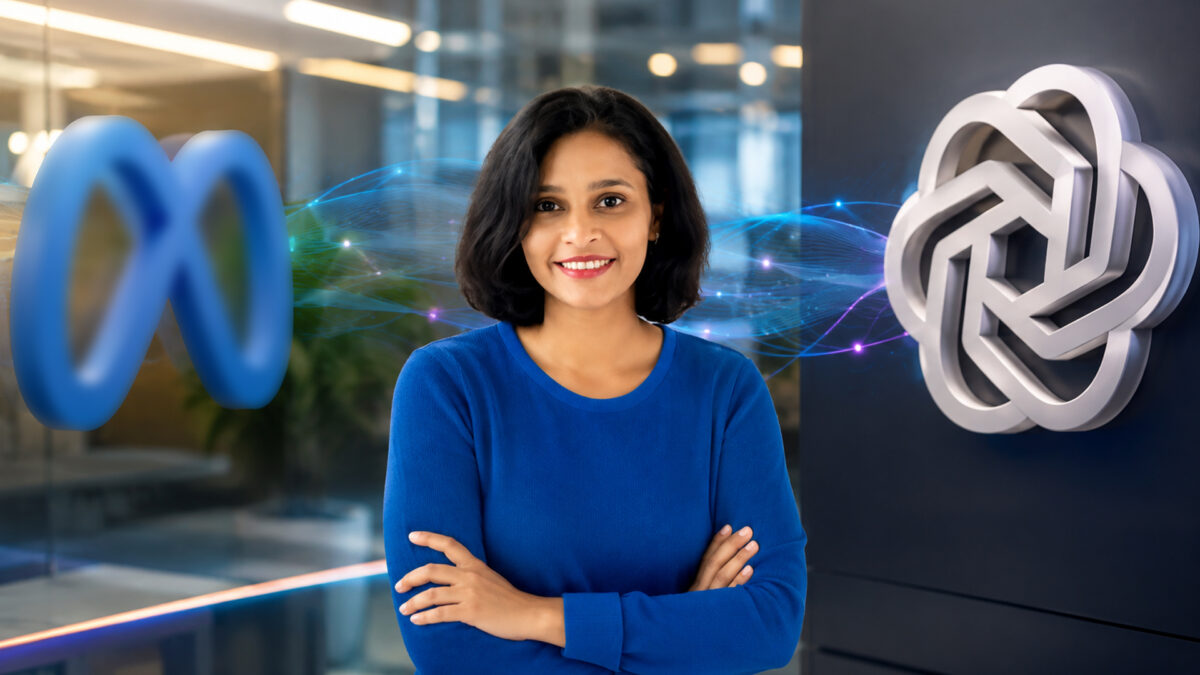
Meta’s India and Southeast Asia chief Sandhya Devanathan is leaving the social media company after more than a decade to join OpenAI, marking a significant movement of senior technology talent from social media towards artificial intelligence.
Devanathan will join OpenAI as vice-president for Southeast Asia and Australia in October. Based in Singapore, she will report to Kiran Mani, OpenAI’s managing director for Asia-Pacific. The newly created position will make her the company’s senior-most executive for the two markets.
Her responsibilities will extend beyond business growth. Devanathan will oversee consumer expansion, enterprise adoption, partnerships, regulatory engagement and operations across Southeast Asia and Australia. She will also work with businesses, institutions and governments to encourage wider adoption of OpenAI’s artificial intelligence products.
The move follows Devanathan’s decision to step down from Meta after a career spanning more than 10 years with the company. She announced her departure in a LinkedIn post on Friday, describing it as a difficult but important career decision. She did not initially disclose where she would be moving, before OpenAI confirmed the appointment.
Devanathan joined Meta in 2016, when the company’s Singapore operation was considerably smaller. During her tenure, she worked across ecommerce and gaming businesses in the Asia-Pacific region and helped expand Meta’s operations in markets including Singapore and Vietnam.
She later took charge of Meta’s Asia-Pacific gaming business before becoming Meta’s India head in 2023. Her responsibilities were subsequently expanded to include Southeast Asia, placing her at the centre of the company’s business strategy across several fast-growing digital markets.
Her departure comes at an important moment for Meta in India. The company has faced increasing scrutiny from Indian authorities over online safety, content moderation and the handling of material on its platforms.
Earlier this month, Meta apologised after Instagram mistakenly restricted a post by Prime Minister Narendra Modi. The incident led the Indian government to summon senior Meta executives, including Chief Global Affairs Officer Joel Kaplan, for an explanation.
Meta has also faced questions over child safety on its platforms. Indian authorities sought an explanation from the company after a report alleged that Instagram advertisements were being used to offer access to child sexual abuse material. Meta said it had removed the offending advertisements and accounts and disputed suggestions that it knowingly targeted such content.
The company said it had removed about 160,000 accounts in India over a six-month period after detecting signals associated with child-exploitative activity. The episode has added to broader concerns around content moderation and platform safety in one of Meta’s largest markets.
Following Devanathan’s exit, Meta India’s managing director Arun Srinivas will report directly to Benjamin Joe, the company’s vice-president for Asia-Pacific. Srinivas is expected to continue leading Meta’s India operations as the company reorganises its regional leadership structure.
For OpenAI, the appointment comes as the ChatGPT maker significantly expands its presence across Asia-Pacific. The company has opened offices in Singapore, Tokyo, Seoul, Sydney and Delhi during the past two years and is also expanding its operations in India.
OpenAI recently appointed former Uber India and South Asia president Prabhjeet Singh as its managing director for India. The appointment strengthened the company’s leadership in what has emerged as one of its most important international markets.
The company has been aggressively building its India business as ChatGPT adoption grows. OpenAI said earlier this year that it had more than 100 million weekly active users in India, with a large proportion using its free or lower-priced Go plans.
It has also announced plans to introduce advertising on ChatGPT’s free and Go tiers in India, initially involving 50 brands and partnerships with major advertising groups. The move signals a growing effort to turn its large Indian user base into a sustainable commercial business.
Devanathan’s appointment fits into that wider expansion strategy. Her experience working with consumers, businesses and regulators across India and Southeast Asia could help OpenAI navigate markets where government engagement and local partnerships are becoming increasingly important to the growth of artificial intelligence.
The shift also highlights the intensifying competition for senior technology talent. Meta has been investing heavily in artificial intelligence and building its own AI capabilities, while OpenAI is expanding beyond ChatGPT into enterprise services, partnerships and regional operations.
The two companies are therefore competing not only for users and technology but also for experienced executives who understand the fast-changing digital markets of Asia.
Devanathan’s move from Meta to OpenAI reflects that changing technology landscape. As artificial intelligence becomes increasingly central to consumer technology and business services, experienced leaders with knowledge of regional markets are becoming valuable assets.