
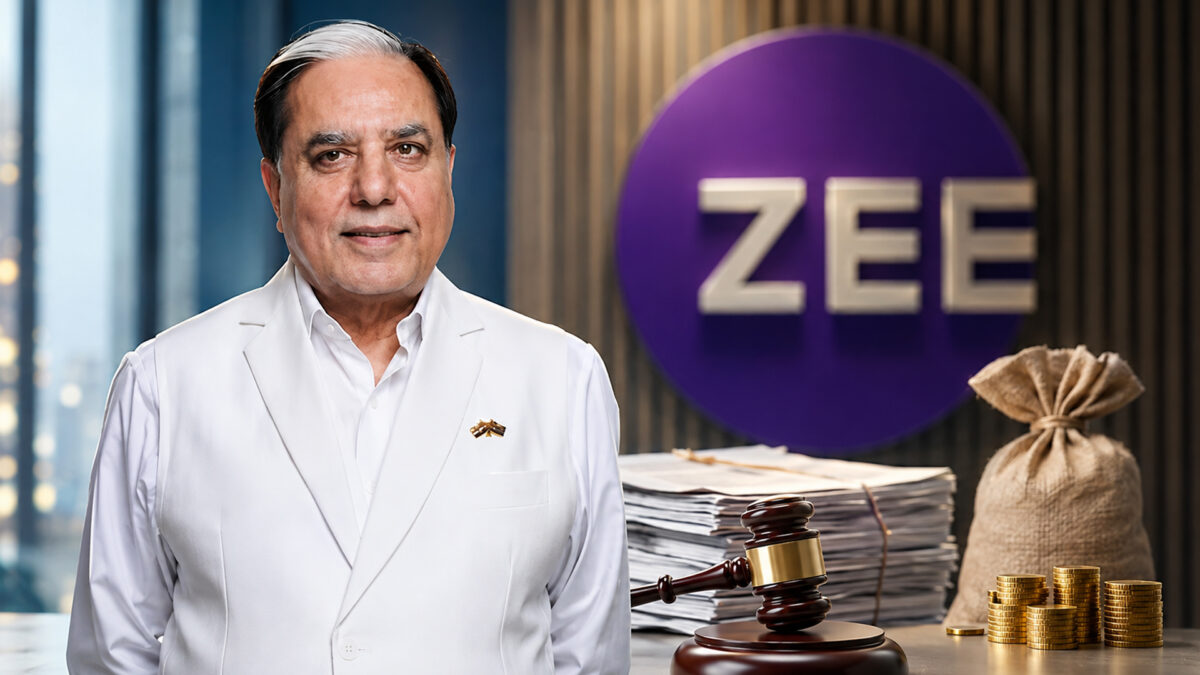
The National Company Law Tribunal (NCLT) has approved a repayment plan under which businessman Subhash Chandra will pay ₹6.5 crore against admitted creditor claims of about ₹22,006.57 crore, leaving lenders with a recovery of only around 0.03%.
The decision means creditors will effectively face a 99.97% haircut on their admitted claims. The plan was approved by NCLT judicial member Nilesh Sharma, who acted as the third member after the original two-member bench delivered a split verdict on the proposal.
Under the approved plan, ₹6.25 crore will be paid to creditors, while ₹25 lakh has been set aside towards the costs of the insolvency process. The amount is extremely small compared with the total claims admitted in Chandra’s personal insolvency proceedings.
The case concerns Chandra’s personal guarantees for borrowings by companies associated with the Essel Group. When those obligations ran into financial difficulties, lenders moved against the guarantees, bringing Chandra’s personal assets and liabilities into the insolvency resolution process.
The size of the gap between the claims and the proposed repayment has made the case unusual. For every ₹100 of admitted claims, creditors would recover only about three paise.
One of the principal objections came from LIC Housing Finance. Its admitted claim stood at around ₹1,322.39 crore, but the proposed repayment was only about ₹38.09 lakh, equivalent to roughly 0.028% of its admitted dues. The lender-led group argued that such a small recovery made the plan unviable and legally questionable.
The objections followed a disagreement within the NCLT itself. The original bench could not reach a common conclusion on whether the repayment plan should be approved. The matter was subsequently referred to a third member to settle the difference.
Nilesh Sharma ultimately backed the plan under Section 114 of the Insolvency and Bankruptcy Code (IBC). A major factor was the voting position of creditors. The proposal had received support from creditors representing 80.81% of the voting share, while those opposing it accounted for less than 20%.
The tribunal placed considerable weight on the principle of commercial wisdom of creditors, under which lenders collectively decide whether a resolution proposal offers the best available outcome. The NCLT’s role, in this context, is primarily supervisory and it does not ordinarily replace the commercial decision of the creditor group with its own assessment.
The tribunal also considered the value of Chandra’s personal assets. The resolution professional’s assessment indicated that the value of his personal estate was lower than the amount offered under the repayment plan. This was important to the tribunal’s reasoning because rejecting the proposal could potentially leave dissenting creditors with little or no prospect of receiving a better recovery.
The NCLT also held that once approved, the repayment plan would be binding on all creditors under the IBC, including those who voted against it. Allowing dissenting creditors to separately pursue recovery of their original claims would undermine the structure of the insolvency resolution process and could result in unequal treatment among creditors.
The decision has nevertheless raised questions about the limits of creditor recovery under India’s insolvency framework. The IBC was introduced to create a time-bound system for resolving financial distress, improving recoveries and balancing the interests of lenders and borrowers.
In this case, however, the approved recovery is exceptionally low. The ₹22,006.57 crore figure represents the claims admitted during the insolvency process; it does not mean that the tribunal has ordered Chandra to repay that entire amount. Instead, the NCLT has approved a resolution under which creditors accept a sharply reduced amount based on the debtor’s financial position and the voting decision of the creditor group.
The tribunal’s decision also highlights the distinction between haircut and recovery. A 99.97% haircut means creditors are accepting that almost the entire admitted claim will not be recovered through this resolution plan. The actual payment of ₹6.5 crore represents only a tiny fraction of the total admitted claims.
The case has also attracted political criticism. Congress leader Jairam Ramesh criticised the decision, arguing that such a steep reduction in creditor recovery raises serious questions about the functioning of the IBC. He described the outcome as more than a haircut and used the term “mundan” to underline the scale of the reduction.
With the NCLT approving the plan, the repayment process can now move forward. The resolution professional has been directed to update the creditor list and take the necessary steps for implementing and distributing the approved amount.
The NCLT has cleared the ₹6.5-crore repayment plan. The decision brings a major stage of Subhash Chandra’s personal insolvency proceedings closer to completion, but the extraordinary 99.97% haircut is likely to keep the debate over creditor protection and India’s insolvency framework alive.