
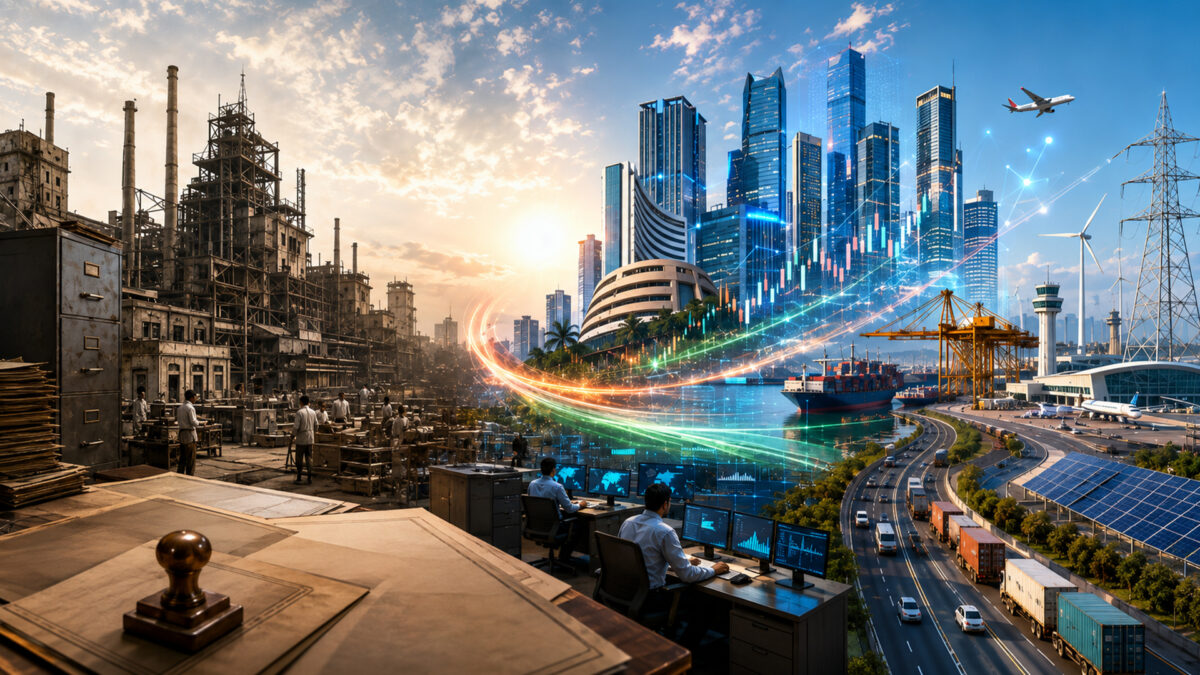
On Independence Day, we usually measure India’s progress in roads, dams, harvests, technology and living standards. We should also measure what happened to the Indian company.
The transformation is extraordinary. India entered freedom with private enterprise operating alongside a powerful colonial commercial legacy. Within a few years, the new republic chose a heavily regulated model of industrial development. The Industries (Development and Regulation) Act of 1951 made government approval central to industrial expansion, and successive policies strengthened what eventually became known as the Licence Raj.
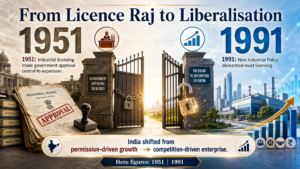
An entrepreneur with capital, customers and a good idea could still find that the most important question was whether New Delhi would permit him to produce more.
Then came 1991.
The New Industrial Policy of July 24, 1991 used unusually blunt language for an official document. It promised to “unshackle” industry from unnecessary bureaucratic control and abolished industrial licensing for all but a short list of sectors.
That change did something more profound than reduce paperwork.
It began shifting economic power from permission to competition.
The results can be seen on a stock-market screen. When the Sensex began on 2 January 1986, it stood at 549.43. On 30 December 2025, it closed at 84,675.08 — more than 150 times higher in nominal terms.
But the more revealing number is four. According to the BSE’s fascinating Sensex@40 study, only four companies have remained continuously in the 30-stock index since its inception: Hindustan Unilever, Larsen & Toubro, ITC and Reliance Industries.
Think about what that means.
India did not simply make its old corporate giants bigger.
It repeatedly created new giants.
Industries once considered the commanding heights lost their dominance. Information technology arrived. Private banking exploded. Telecom transformed itself. Pharmaceuticals went global. Consumer businesses multiplied. New financial companies, technology platforms, airlines, infrastructure developers and renewable-energy businesses emerged.
26 places in India’s best-known stock-market index eventually changed hands. That is not corporate instability. That is corporate Darwinism!
A healthy capitalist system should not guarantee immortality to yesterday’s champions. It should make room for tomorrow’s.
The machinery around companies changed almost as dramatically as the companies themselves. SEBI gained statutory powers in 1992. Screen-based trading replaced much of the noise and opacity of physical trading floors. The Depositories Act of 1996 helped turn the paper share certificate — with its transfer forms, signatures, delays and risk of loss or forgery — into an electronic record.

By March 2026, India had 22.5 crore demat accounts. Household participation has moved equally fast. SEBI’s latest annual report counts 10.45 crore active systematic investment plan accounts. The mutual-fund industry had 6.1 crore unique investors, with Tier-III cities accounting for an astonishing 55% of that investor base.
The Indian stock market, once the preserve of brokers and wealthy urban families, increasingly belongs to people investing a few thousand rupees a month from towns across the country.
Capital itself has become more Indian. Domestic institutional investors held a record 17% of Indian equities by March 2026, according to SEBI, while foreign portfolio ownership had fallen to a 15-year low of 15.8%. India’s aggregate stock-market capitalisation stood at ₹411.6 lakh crore, making it the world’s fifth-largest equity market.
Companies raised a record ₹2.3 lakh crore through public equity issues, including rights issues, in 2025-26. And the Ministry of Corporate Affairs now counts 21,55,827 active companies and another 5,13,790 active LLPs. In July 2026 alone, 26,407 companies were incorporated.
Governance changed too. No serious observer would claim that India has solved promoter dominance, conflicts of interest, boardroom failures or the protection of minority shareholders. Clearly, corporate governance remains unfinished work.
But compare the institutional architecture. Modern India has independent directors, audit committees, continuous disclosure requirements, takeover regulations, related-party transaction rules, electronic market surveillance and statutory securities regulation.
Even corporate failure has been institutionalised. Before the Insolvency and Bankruptcy Code, a failed business could remain trapped for years while creditors watched assets deteriorate. A decade after the IBC’s enactment in 2016, 8,987 corporate insolvency cases had been admitted and 7,102 closed by March 2026. Resolution plans in 1,419 cases had generated more than ₹4 lakh crore for creditors. Another 30,000-plus cases involving obligations estimated at nearly ₹14 lakh crore were settled before formal admission.
The system remains slower than it should be. Yet bankruptcy finally carries a consequence that Indian capitalism once struggled to impose: capital can change hands when its owner fails to use it well.

Technology has rewritten the corporate map as well. A country once associated with textile mills, steel plants and trading houses now exports software, designs pharmaceuticals, runs global capability centres, manufactures smartphones and finances vast renewable-energy projects. Mobile-phone production alone rose from roughly ₹18,000 crore in 2014-15 to ₹6.27 lakh crore in 2025-26 — a 33-fold increase. Mobile phones have become India’s single largest export item.
Yet one transformation fascinates me more than most because it involves the hardest form of enterprise: building things in the physical world.
Software can scale at extraordinary speed. Infrastructure cannot. A port needs land, dredging, cranes, rail links and years of execution. A power plant must actually produce electricity. Transmission lines must cross hundreds of kilometres. Airports must move passengers safely, hour after hour.
For my money, Gautam Adani has become India’s finest builder of large-scale private infrastructure in the post-liberalisation era.
His story also captures what changed in Indian capitalism. Adani did not begin with a century-old industrial inheritance. His business started in 1988, initially in commodity trading. What followed was a move into ports, logistics, power, transmission, renewable energy, airports and other hard infrastructure.
The scale of his expansion drive now deserves attention even from those who have little interest in corporate personalities.
In 2025-26, his ports and logistics company, Adani Ports and Special Economic Zone, handled 500.8 million tonnes of cargo and accounted for 27.1% of India’s port volumes. Its container share reached 45.5%. Its integrated network now stretches from ports into rail, warehousing, trucking, marine services and logistics parks.

His airport management arm, Adani Airport Holdings, handled 96.4 million passengers in FY26 — roughly a quarter of India’s air traffic — while facilitating 33% of the country’s air cargo. His renewables company, Adani Green Energy, operates 19.3 GW of renewable-energy capacity after adding more than 5 GW in a single year, while also building the world’s largest solar plant in Khavda, Gujarat. Adani Energy Solutions operates 27,949 circuit kilometres of transmission lines across 16 states. Adani Power, India’s largest private thermal-power producer, operates 18,150 MW.
These are jaw-dropping numbers for a country like India in a jaw-dropping variety of critical sectors. Ports. Airports. Solar. Wind. Transmission. Thermal. Logistics. Rail. Roads. Defence. Cement. Gautam Adani is unstoppable. Just like the India of today.
Infrastructure is unusually resistant to rhetoric: a port either moves cargo or it does not; a transmission line either carries power or it does not; an airport either handles passengers or it does not.
Measured that way, Gautam Adani’s achievement ranks among the greatest enterprise-building stories of not just independent India but of the whole wide world.
The larger story, however, belongs to India rather than to any one businessman. The Tatas, Birlas and other industrial families helped build early Indian industry. Public-sector enterprises supplied steel, energy, banking and heavy industrial capacity when private capital could not. Liberalisation unleashed Reliance, Infosys, HDFC, Bharti and a new generation of businesses. Today, startups, manufacturers, financiers and infrastructure developers compete for capital in markets unimaginable to the entrepreneur of 1947.
Every era produced its champions.
Every era also displaced some of the previous ones.
That may be the most encouraging fact of all.
India Inc’s achievement is not that particular companies became enormous. It is that India gradually constructed a system capable of creating new companies, financing them, regulating them, disciplining failure and allowing challengers to replace incumbents.
From industrial licences to competitive markets. From paper certificates to 22.5 crore demat accounts. From a few dominant business houses to more than 21 lakh active companies. From domestic capital scarcity to a ₹411.6-lakh-crore stock market. From a commodity trader founded in 1988 to an infrastructure group moving one-quarter of India’s port cargo and airport traffic.
Political independence arrived at midnight on August 15, 1947.
Economic freedom took much longer.
India Inc’s 79-year journey shows just how much can happen once enterprise is progressively allowed to breathe.