
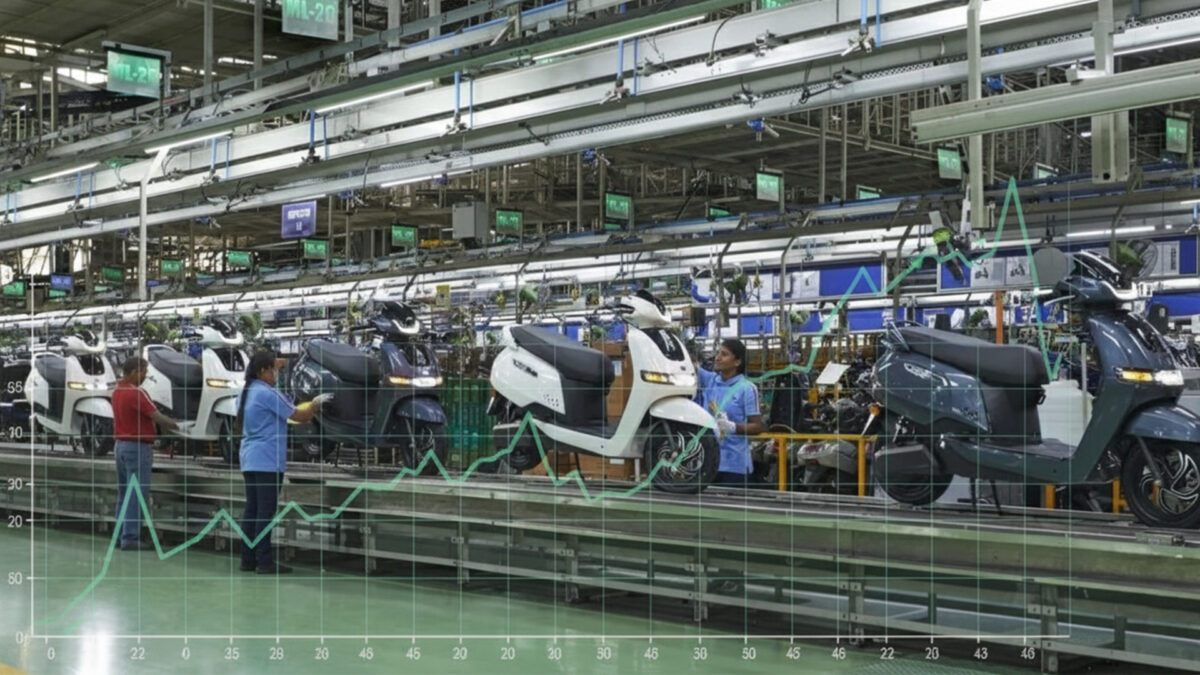
TVS Motor Company reported a robust set of results for the second quarter ended September 30, 2025, with standalone net profit rising 37 percent year-on-year to ₹906 crore and operating revenue climbing 29 percent to a record ₹11,905 crore, the company said on Tuesday.
The earnings beat was driven by healthy volume growth across the company’s product portfolio and an improvement in operating leverage.
Total vehicle sales grew about 23 percent year-on-year in the quarter, led by a 20 percent rise in motorcycle volumes, a 30 percent jump in scooters and a 41 percent increase in three-wheelers, the company said.
These volume gains translated into stronger operating EBITDA of ₹1,509 crore, up roughly 40 percent year-on-year, and pushed the EBITDA margin to 12.7 percent from 11.7 percent a year earlier.
TVS’s profit before tax rose in tandem to ₹1,226 crore, reflecting both top-line expansion and better cost absorption across factories and distribution channels.
Management highlighted that a favorable product mix, improved realizations and disciplined cost control helped underpin the margin recovery in the quarter.
Analysts noted that the company’s emphasis on higher-margin models and exports contributed to the outsized profit growth relative to revenue.
The company reported strong traction in overseas markets, with international two-wheeler volumes up 31 percent, reinforcing TVS’s strategy of balancing domestic demand with export opportunities.
The board also pointed to expanding orderbooks in key markets and incremental gains from new model launches during the year.
Electric vehicle performance remained an area of focus. EV volumes grew by a single-digit percentage in the quarter despite constraints around magnet availability that limited production ramp-up, the company said.
Management reiterated ongoing investments in EV technology and said it remained committed to scaling its electric portfolio as supply-chain bottlenecks ease.
Analysts expect EVs to become a progressively larger part of TVS’s revenue mix over the next several years, although margins in the segment will depend on component cost normalization.
Looking ahead, the company cautioned that macroeconomic risks such as commodity price swings and currency volatility could affect near-term profitability, even as it pursues market share gains and product upgrades.
Management said it would continue to focus on converting order momentum into sustainable earnings through product differentiation, cost discipline and geographic diversification.
Investors and industry watchers will now be watching the company’s three-to-five quarter trajectory for evidence that the mix shift toward higher-value models and the EV transition are translating into durable margin improvement and return-on-capital gains.
Also Read: Adani Green Energy Reports 39% YoY Surge in Energy Sales