
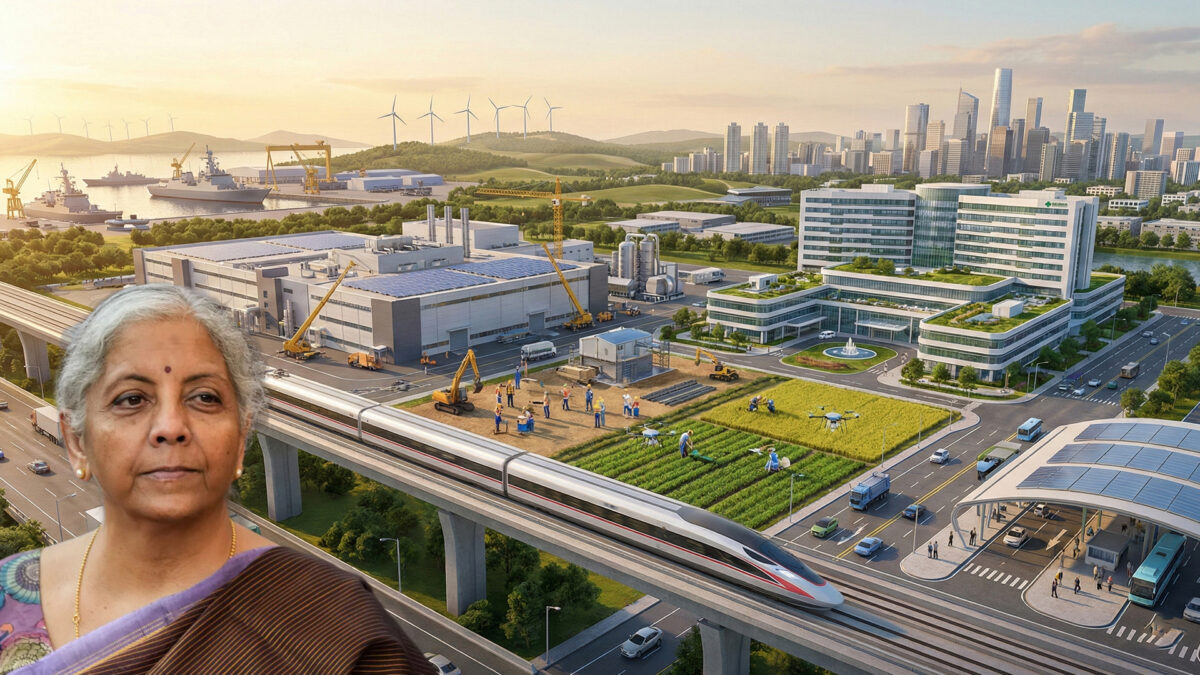
Finance Minister Nirmala Sitharaman presented the Union Budget 2026–27 in Parliament on 1 February 2026, laying out a roadmap for economic growth, job creation, healthcare improvement, defence self-reliance, and tax simplification. The Budget seeks to maintain fiscal discipline while supporting investment-led development across key sectors of the economy.
At the macroeconomic level, the government has set the fiscal deficit target at 4.3% of GDP, reflecting its commitment to gradual fiscal consolidation. Total expenditure has been increased, with a strong focus on capital spending, which has been raised to a record ₹12.2 lakh crore, signalling a continued emphasis on infrastructure development and long-term productivity.
Infrastructure remains a central pillar of the Budget. The government announced the creation of seven high-speed rail corridors connecting major urban and industrial hubs to improve connectivity and reduce travel time. A new Dedicated Freight Corridor from Dankuni to Surat is expected to enhance cargo movement, making trade faster and more cost-efficient. The development of 20 National Waterways aims to expand inland shipping and reduce the environmental impact of transport, while urban metro networks, road projects, and multimodal transport hubs will enhance last-mile connectivity. These investments are expected to generate employment and boost the efficiency of supply chains across the country.
The Union Budget also places strong emphasis on manufacturing and strategic industries. The India Semiconductor Mission 2.0 was announced to expand domestic chip manufacturing, research, and design capabilities, supporting India’s push for technological self-reliance. To reduce dependence on imports, Rare Earth Corridors will be developed in mineral-rich states, supporting clean energy, electronics, and defence industries. Additionally, the ₹10,000 crore Biopharma Shakti initiative seeks to position India as a global hub for biopharmaceuticals, with investments in vaccine production, biologics, and essential medicines. Measures to modernize textiles, container manufacturing, industrial parks, and promote startups are expected to generate employment and enhance exports.
Healthcare and social development received significant attention in the Budget. Expansion of cancer care infrastructure and early detection programmes was announced to improve access to treatment. Mental health services will be strengthened through district-level facilities, integration into primary healthcare, and expanded counselling and emergency support. The Budget also proposes the establishment of three new All India Institutes of Ayurveda to promote research, education, and the global outreach of AYUSH. Additional support has been allocated to public hospitals, life-saving medicines, and emergency care facilities, reflecting a comprehensive approach to health and wellness.
Defence and national security continue to be priorities. The Budget allocates higher funding for domestic defence manufacturing, research and exports under the ‘Make in India’ framework. Development of defence corridors and public-private partnerships is expected to reduce import dependence and strengthen India’s strategic autonomy.
The government has also taken measures to support farmers, rural communities, and MSMEs. Initiatives to improve productivity, promote high-value crops, strengthen fisheries, and enhance irrigation have been outlined, along with the use of digital platforms to improve access to markets and credit for farmers. MSMEs and startups are set to benefit from a proposed ₹10,000 crore Growth Fund, simplified compliance processes, and easier access to credit.
On the taxation front, the Budget introduces relief and simplification. A new Income Tax Act, effective from April 2026, will streamline forms and filing processes. Deadlines for revised returns have been extended, and penalties for minor defaults reduced. TCS rates on overseas education, medical treatment, and foreign travel have been lowered to 2%, while the Minimum Alternate Tax for companies has been cut to 14%. Tax incentives have also been provided to foreign cloud service providers operating from Indian data centres to attract investment in the digital economy.
The Union Budget 2026–27 seeks to balance fiscal prudence with growth-oriented reforms, focusing on infrastructure, manufacturing, healthcare, defence, rural development, and tax simplification.
Also Read: Sensex up over 100 points, Nifty above 24,800