
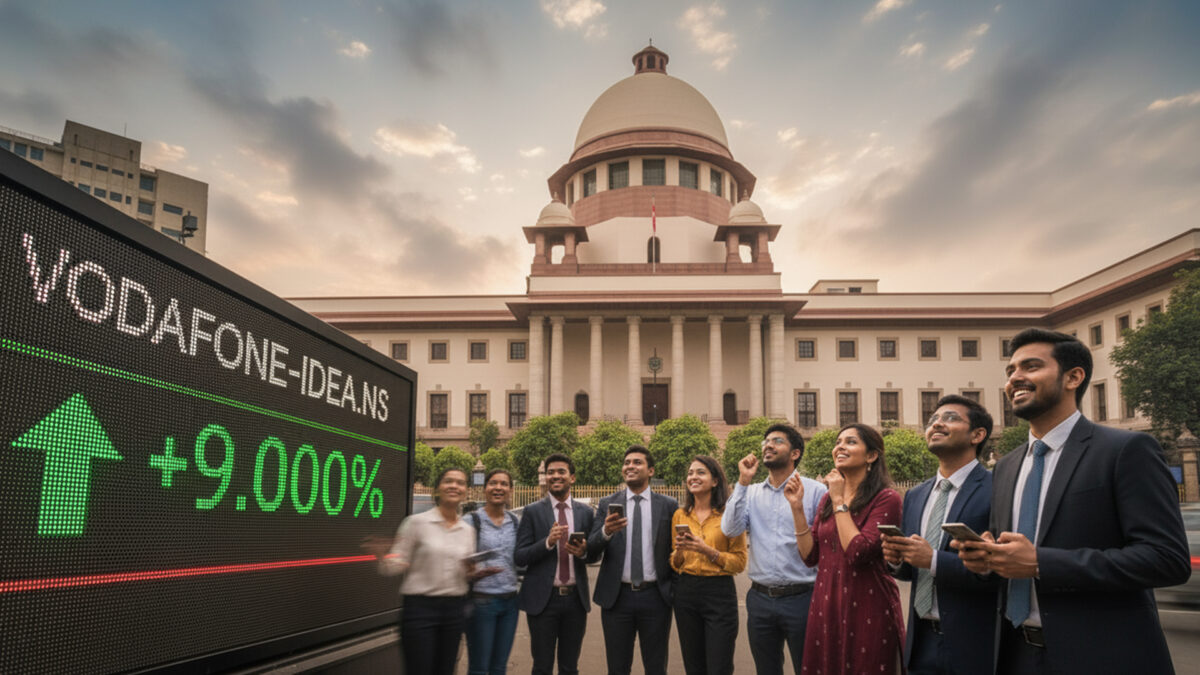
Vodafone Idea Ltd shares surged on Monday after the Supreme Court of India permitted the government to re-examine the telecom operator’s adjusted gross revenue (AGR) liabilities, offering potential relief in a long-running dispute that has weighed heavily on the company’s finances.
The stock, which opened more than 2 percent lower, reversed course, soaring about 11.4 percent to a fresh 52-week high of ₹10.52 on the National Stock Exchange. As of 12:20 p.m. the stock was at ₹10.10, up about 5 percent.
The jump followed a bench led by Chief Justice B. R. Gavai, along with Justices K. Vinod Chandran and Vipul M. Pancholi, ruling that there was no reason why the Union government should be prevented from reconsidering the issue, which the court deemed a policy matter.
The judgment effectively opens the door for the Department of Telecommunications (DoT) to re-evaluate Vodafone Idea’s dues under the AGR framework — a metric used to calculate licence fees and spectrum usage charges owed to the government.
The Centre, represented by Solicitor General Tushar Mehta, told the court that the government held nearly 49 percent equity in Vodafone Idea following a debt-to-equity conversion, making it a direct stakeholder in the company’s future.
Mehta noted that the government was exploring ways to arrive at a viable solution, subject to judicial approval, acknowledging the company’s large subscriber base and strategic significance in India’s telecom market.
Vodafone Idea had filed a fresh plea challenging the DoT’s demand of ₹5,606 crore related to FY 2016–17, seeking a comprehensive reassessment in line with the “Deduction Verification Guidelines” issued in February 2020.
The company contends that the DoT’s computation included duplications and arithmetical errors, inflating its dues beyond what was legally justified. The telecom firm has repeatedly sought relief in the matter, maintaining that it faces existential pressure under the current liability structure.
The Supreme Court’s 2019 ruling on AGR had originally expanded the definition of revenue to include both telecom and non-telecom income, such as interest and asset sales.
In 2020, the court allowed telecom operators a ten-year window to pay their dues — which totaled ₹93,520 crore for the sector — mandating 10 percent payment by March 2021, with the remainder to be paid annually through March 2031.
However, the court also held that the DoT’s assessments were final and not subject to re-evaluation, rejecting pleas for correction of alleged calculation errors in 2021.
The latest order, while not altering that principle, allows the government to revisit the issue on its own accord given its equity stake and policy prerogatives.
Analysts said the decision marks a significant development for Vodafone Idea, offering a potential lifeline to a company struggling with debt and capital constraints.
The ruling is also expected to have positive spillover effects for infrastructure players such as Indus Towers, given Vodafone Idea’s status as a key tenant.
Still, the court emphasized that its decision applied only to the “peculiar facts and circumstances” of the case, making it clear that the underlying DoT demand remains legally valid for now.
The government’s next steps will be crucial in determining whether Vodafone Idea’s financial and operational outlook can improve meaningfully.
Investors and analysts alike are now watching closely to see how the DoT proceeds and whether a broader policy recalibration follows in India’s telecom sector.
Also Read: Novartis To Acquire Avidity Biosciences In US$12 Billion Deal