
The Indian Space Research Organisation (ISRO) is gearing up for one of its most demanding operational phases in recent years, with seven space missions planned up to March 2026. The ambitious launch schedule reflects India’s expanding role in space science, commercial launches, and advanced technology development.
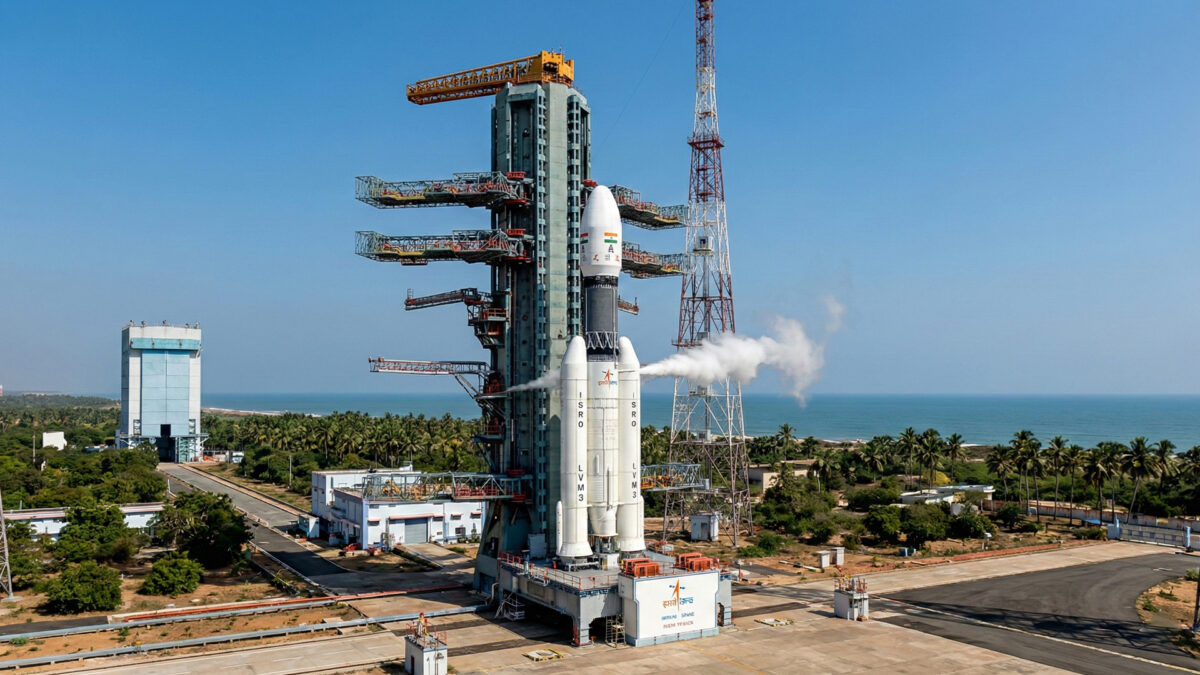
The campaign is expected to begin shortly with the launch of Bluebird-6, a large communication satellite built for US-based company AST SpaceMobile. The satellite will be carried aboard India’s heavy-lift LVM3 rocket, marking another milestone for ISRO’s commercial arm, New Space India Limited (NSIL), which is managing the international contract.
A key focus during this period will be the Gaganyaan human spaceflight programme. ISRO plans to conduct the first uncrewed Gaganyaan mission early next year. The flight will carry a humanoid robot, Vyommitra, and will test crucial systems such as launch performance, on-orbit operations, and safe re-entry and recovery of the crew module. A second uncrewed test mission is also planned before India aims to send astronauts into space by 2027.
Another major development is the growing role of Indian industry in rocket manufacturing. For the first time, a PSLV built by private industry will be launched. This mission will place Oceansat, an earth observation satellite, into orbit along with the Indo-Mauritius Joint Satellite and LEAP-2, developed by space startup Dhruva Space. The move follows a contract awarded to a consortium led by HAL and Larsen & Toubro to manufacture multiple PSLV rockets.
ISRO will also conduct additional PSLV and GSLV-Mk II missions during this period. These include launching EOS-N1, carrying several small satellites for Indian and foreign customers, and placing EOS-5 (GISAT-1A) into orbit, replacing a satellite lost due to a launch failure in 2021.
Technology demonstration will remain a priority. The PSLV-63 mission will test high-thrust electric propulsion, quantum communication techniques, and indigenous satellite components. ISRO also plans a mission using the Small Satellite Launch Vehicle (SSLV), strengthening India’s ability to serve the growing small-satellite market.