
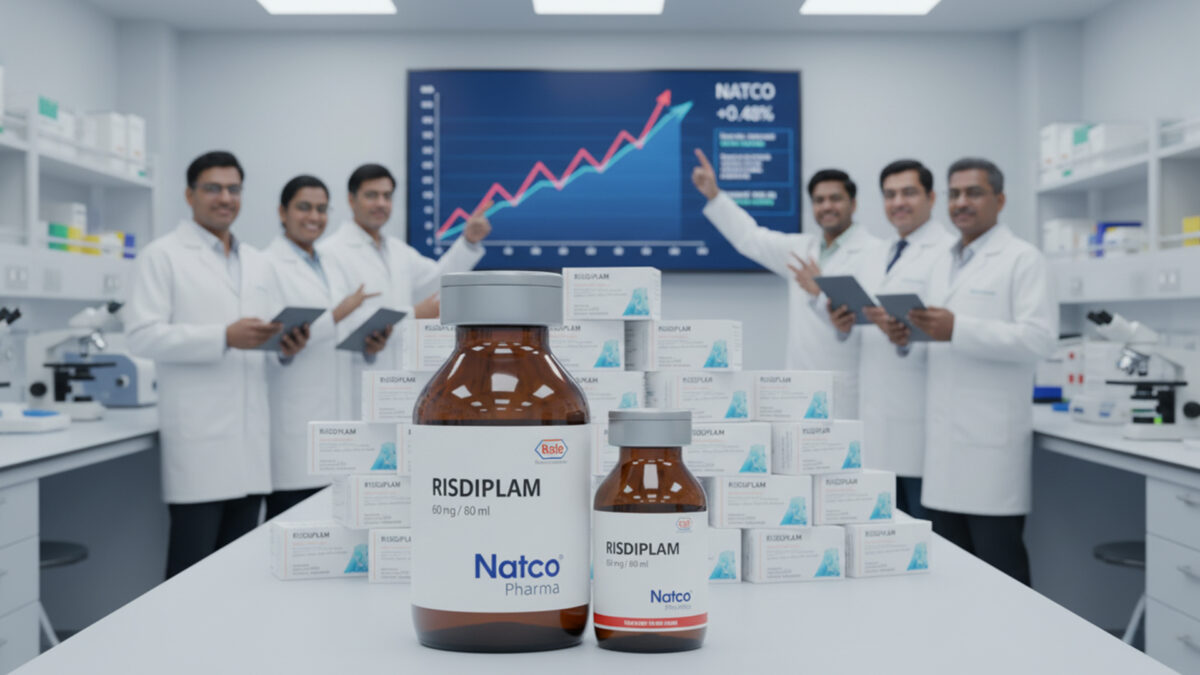
Shares of Natco Pharma rose on Friday following a significant legal victory in its ongoing patent dispute with Swiss pharmaceutical giant Roche.
The Supreme Court of India dismissed Roche’s plea to restrain Natco from manufacturing and selling a generic version of Risdiplam, a drug used to treat Spinal Muscular Atrophy (SMA).
Following the ruling, Natco Pharma’s shares rose, reflecting positive investor sentiment.As of 3:15 pm, the stock was up about 0.63% to ₹827.00, having reached a high of ₹847.90 earlier in the day.
The Court upheld the interim order issued by the Delhi High Court, allowing Natco to proceed with the production and sale of the generic drug.
A bench of Justices P.S. Narasimha and A.S. Chandurkar emphasized that their observations were limited to the interim nature of the High Court order and did not address the merits of the case.
The Supreme Court urged the Delhi High Court to expedite the hearing of Roche’s patent suit against Natco to ensure a timely resolution.
The bench noted that both the single bench and division bench of the Delhi High Court had already entered concurrent findings in favor of Natco.
Roche had argued that it held the patent for Risdiplam and that Natco’s generic version was developed through reverse engineering. The company highlighted its substantial investment in research and development, as well as global patent protection for the drug in over sixty countries.
Roche contended that granting an injunction was necessary to prevent potential infringement and protect its intellectual property rights. However, the Supreme Court declined to interfere with the interim order, stating that the balance of convenience did not justify halting Natco’s sale of the generic drug.
The approval of Natco’s generic Risdiplam marks a major breakthrough for patients in India. The generic drug is priced at ₹15,900 per 60 mg/80 ml bottle, a dramatic reduction from Roche’s original price of approximately ₹6 lakh.
This significant price difference is expected to make the life-saving treatment accessible to a far larger segment of patients suffering from SMA.
Patient advocacy groups and healthcare experts have welcomed the decision, highlighting its potential to reduce the financial burden on families affected by this rare and debilitating genetic disorder.
Despite this boost, the company has faced challenges in 2025, with its stock having declined by as much as 40% earlier in the year.
The legal victory may support a recovery in the company’s market performance and reinforce its position in the pharmaceutical sector.
The case also underscores the ongoing tension between intellectual property rights and public health considerations in India.
The Supreme Court’s decision could set a precedent for future disputes involving access to essential medications, particularly for rare diseases.
It highlights the judiciary’s role in balancing the protection of patent rights with the broader objective of ensuring affordable healthcare for patients.
Also Read: Jio Financial’s Q2 Profit Nears ₹700 Crore as Operating Income Surges