
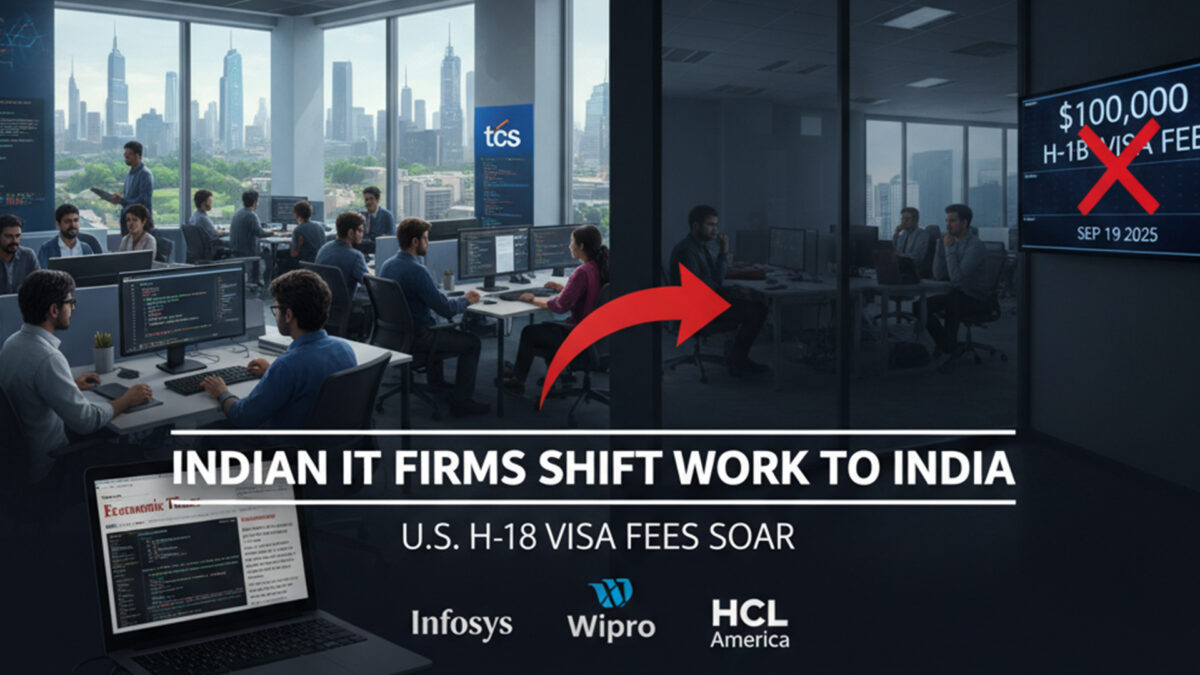
Leading Indian IT services companies are signaling a major shift in their operations following the U.S. administration’s announcement of a steep hike in H-1B visa fees to $100,000.
According to a report by the Economic Times (ET), several top Indian firms have told the government they plan to reduce their reliance on H-1B visas and move more work to India for U.S. clients.
The fee increase, announced on September 19, 2025, has raised concerns among Indian IT companies about exposure to uncertainties in U.S. immigration policy that could disrupt long-term business planning. India has historically been the largest beneficiary of the H-1B program, with nearly 71 percent of the visas issued to Indian nationals.
Citing officials, ET reported that firms including Tata Consultancy Services (TCS), Infosys, LTI Mindtree, HCL America, Wipro, Tech Mahindra, and L&T Technology Services are re-evaluating the scale of their on-site presence in the U.S. Data from the U.S. government shows that TCS ranked second among the top 100 H-1B recipients with 5,505 visas, while Infosys received 2,004, and LTI Mindtree 1,044. Together, the top seven Indian firms among the 100 largest H-1B beneficiaries account for 14,565 visas.
An official familiar with the matter told ET that larger U.S. tech firms such as Amazon, Microsoft, Apple, Meta, and Walmart would also face the biggest challenges, as they hold far more H-1B visas. “It’s a bigger problem for big tech companies like Amazon, Microsoft, Apple, Meta, and Walmart to tackle as they have substantially more such visas,” the official said.
The visa fee increase is expected to have an immediate impact on staffing decisions and cost structures. Several Indian IT executives have indicated that while some work can continue in the U.S., a larger share will be handled from Indian delivery centers. This strategic pivot aligns with Prime Minister Narendra Modi’s push for greater self-reliance across sectors, including technology.
The ET report noted that startup AI firms, many of which had considered relocating teams to the U.S. to leverage the global innovation ecosystem, may now prefer to keep operations in India. This could influence the growing AI sector, as companies weigh cost, talent availability, and regulatory risks in making expansion decisions.
Analysts say the move may accelerate India’s position as a global IT hub, with more projects being executed from domestic delivery centers rather than offshore locations. “The visa policy change may encourage firms to invest in India-based talent and technology infrastructure,” said a senior IT analyst.
Despite the fee hike, major Indian IT companies continue to emphasize their commitment to U.S. clients. TCS, Infosys, and Wipro executives are reportedly engaging with clients to ensure project continuity while adjusting staffing plans. At the same time, the companies are seeking ways to manage visa-dependent costs without affecting delivery timelines or contractual obligations.
Market reaction has been mixed. While some IT stocks fell marginally due to concerns over higher costs, investors see potential long-term benefits from increased operational control and reduced dependence on U.S. immigration policies.
The shift away from H-1B dependency comes amid broader global concerns over talent mobility and rising costs in the U.S., especially in sectors such as AI and advanced technology services where specialized talent is critical. Indian IT firms appear to be responding proactively, signaling a structural recalibration in how cross-border services are delivered.
With the H-1B fee hike now in effect, India’s IT industry is set to reassess not only U.S.-bound staffing but also global delivery strategies. ET’s reporting suggests that the move could reshape outsourcing patterns, with a stronger emphasis on India as the backbone of IT service delivery for major American clients.
Also Read: Alkem launches Pertuza biosimilar to make breast cancer treatment more accessible