
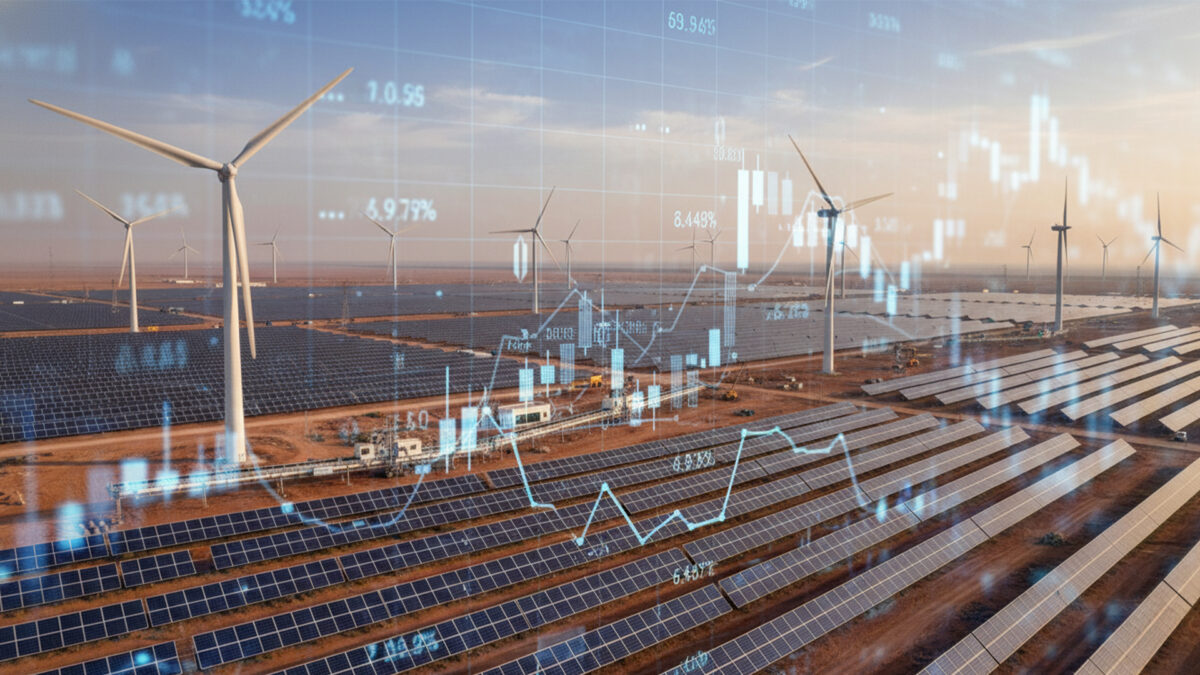
Adani Green Energy Ltd (AGEL), India’s largest renewable energy company, reported robust financial and operational growth for the first half of fiscal year 2026, driven by aggressive capacity expansion and strong plant performance.
The company’s energy sales rose 39 percent year-on-year to 19,569 million units, underpinned by significant additions in renewable capacity and higher generation efficiency.
Revenue from operations grew 26 percent to ₹6,088 crore in H1 FY26, compared with ₹4,836 crore in the corresponding period last year.
EBITDA increased 25 percent year-on-year to ₹5,651 crore, surpassing the company’s entire annual EBITDA for FY23, while maintaining an industry-leading EBITDA margin of 91.8 percent.
Cash profit surged 17 percent to ₹3,094 crore from ₹2,646 crore in the previous year, highlighting AGEL’s strong cash flow generation and disciplined cost management.
In the second quarter alone, revenue from power supply increased 20 percent year-on-year to ₹2,776 crore, while quarterly EBITDA rose 19 percent to ₹2,543 crore.
Cash profit for the quarter grew 8 percent to ₹1,349 crore, underscoring the company’s steady financial momentum.
AGEL attributed this performance to its greenfield capacity additions, deployment of advanced renewable technologies, and strong operational execution.
During the first half of FY26, the company added 2,437 MW of new capacity, accounting for nearly three-fourths of its total capacity addition in FY25.
Over the last twelve months, AGEL’s greenfield additions totaled 5,496 MW, comprising 4,200 MW of solar capacity—of which 2,900 MW was in Khavda, Gujarat—491 MW of wind capacity, and 805 MW of hybrid capacity.
This expansion drove a 49 percent increase in AGEL’s operational capacity, which now stands at 16.7 GW, solidifying its position as India’s largest renewable energy player. The company’s generation during the period reached 19.6 billion units of clean energy, equivalent to the annual power consumption of an entire country like Croatia.
“Having already added 2.4 GW renewable capacity in the first half of FY26, we are on a firm path to achieve 5 GW capacity addition for the full year and remain on track to reach our 50 GW target by 2030,” said Ashish Khanna, CEO of Adani Green Energy Ltd. “Our progress in developing the 30 GW renewable energy plant at Khavda in Gujarat is a testament to our execution strength and commitment to India’s energy transition. We continue to adopt cutting-edge technologies and digital tools to enhance operational efficiency and safety across our assets.”
The company’s operations and maintenance framework, managed in partnership with Adani Infra Management Services Pvt Ltd, leverages advanced data analytics, artificial intelligence, and machine learning.
This digital integration has helped improve plant availability and reduce O&M costs, supporting AGEL’s industry-leading EBITDA margin.
The company’s electricity generation exceeded its power purchase agreement (PPA) commitments, achieving 57 percent of the annual target within the first half of the fiscal year.
A major driver of AGEL’s growth is the ongoing development of the world’s largest renewable energy plant at Khavda in Gujarat, spread over 538 square kilometers—five times the size of Paris.
The project, which will reach 30 GW capacity by 2029, currently has an operational portfolio of 7.1 GW of solar, wind, and hybrid installations. The site utilizes cutting-edge renewable technologies, including bifacial solar modules, smart trackers, and 5.2 MW onshore wind turbines—among the largest in India.
The company has also deployed waterless robotic cleaning systems, which eliminate water usage for module maintenance while enhancing generation efficiency.
AGEL’s sustainability leadership has been widely recognized. The company ranks first in India and seventh globally in the renewable energy sector in the latest ESG assessment by Sustainalytics.
It was also named “Energy Transition Company” and “Energy Company of the Year – Renewables” at the ET Energy Leadership Awards 2025.
Adani Green Energy Ltd currently operates a renewable portfolio of 16.7 GW across 12 Indian states and aims to achieve 50 GW by 2030 in alignment with India’s decarbonization goals.
Its portfolio is certified water positive, single-use plastic free, and zero waste-to-landfill—reinforcing its commitment to sustainable growth and leadership in the global clean energy transition.
Also Read: Indian Oil Swings to Strong Q2 Profit on Refining Margin Boost