
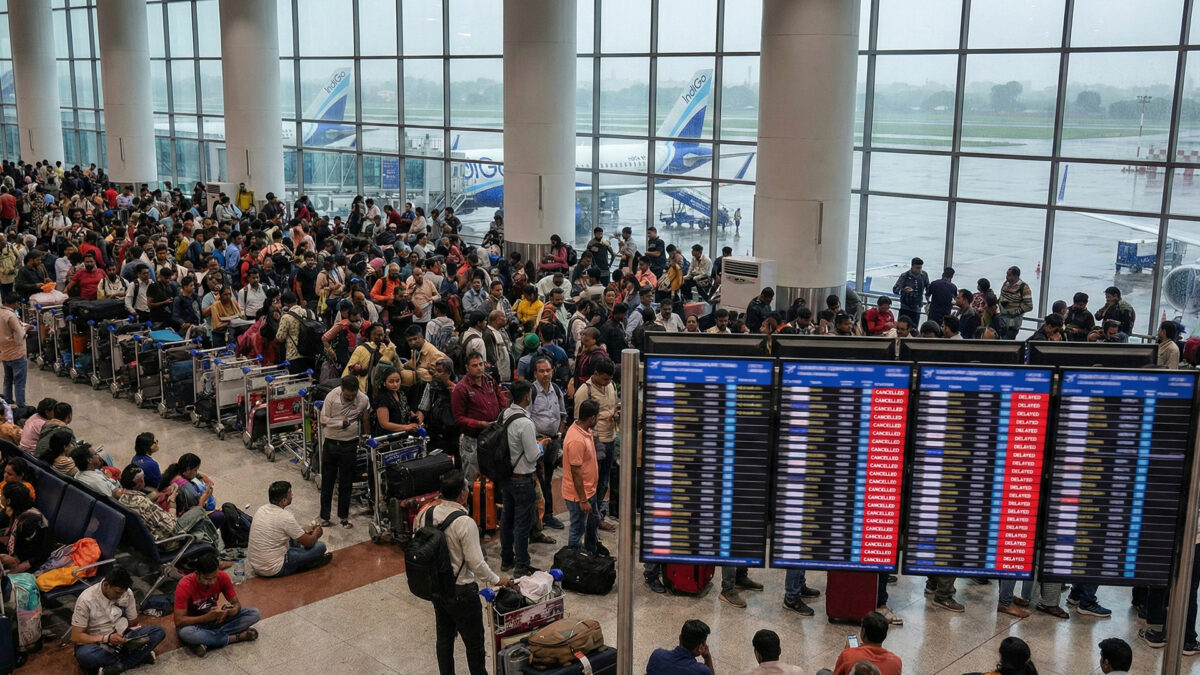
IndiGo, India’s largest airline by market share, is navigating one of its most prolonged operational disruptions in recent years, as widespread flight delays and cancellations entered their fifth consecutive day afftecting more than 1000 fights across India. What began as a roster and crew-duty alignment issue early in the week has now evolved into a sustained operational challenge affecting its nationwide network and prompting close regulatory scrutiny.
According to industry sources, the disruptions stem from a combination of crew shortages, last-minute duty realignments, and the airline’s ongoing transition to new Flight Duty Time Limitations (FDTL) norms. The Directorate General of Civil Aviation (DGCA) has sought detailed explanations from the carrier, asking IndiGo to map out corrective plans that ensure network stability, adequate crew availability, and compliance with staffing benchmarks during high-traffic periods.
Operational metrics have been under pressure, with dozens of cancellations and significant delays across major metros including Delhi, Mumbai, Bengaluru, Hyderabad, and Kolkata. The extended strain has forced IndiGo to reassign aircraft, redesign flight rotations, and stagger departures in an effort to restore punctuality. However, the cascading effect of earlier delays has continued to disrupt the airline’s tight turnaround model, leading to network-wide congestion.
From a corporate standpoint, the situation has raised questions around workforce planning, seasonal capacity management, and the airline’s preparedness for regulatory transitions. Analysts note that IndiGo’s scale—operating over 2,000 daily flights—makes it particularly vulnerable to systemic shocks, where localized crew shortages can ripple across the network.
The airline has issued multiple public statements acknowledging the disruption, saying it is “working around the clock” to stabilise operations. It has deployed additional staff for passenger handling, strengthened customer communication, and activated contingency rostering teams. IndiGo is also believed to be evaluating medium-term structural adjustments to prevent a repeat of this week’s events.
Despite the corrective measures underway, IndiGo’s recovery curve remains gradual, with residual delays expected to persist until crew schedules are fully realigned. The carrier has enhanced operational oversight, activated crisis-management protocols, and is coordinating closely with airport operators to streamline passenger handling. Analysts note that while IndiGo has historically demonstrated strong operational resilience, this episode highlights the growing importance of agile workforce planning and scenario-based scheduling models—especially as regulatory frameworks evolve.
As operations gradually stabilise, IndiGo’s management is expected to conduct an internal review to assess staffing buffers, duty roster flexibility, and long-term preparedness for similar disruptions. The outcome, coupled with DGCA guidance, will likely shape the airline’s operational strategy in the coming months, marking this week’s disruptions as a pivotal moment for its network management capabilities and service reliability.