
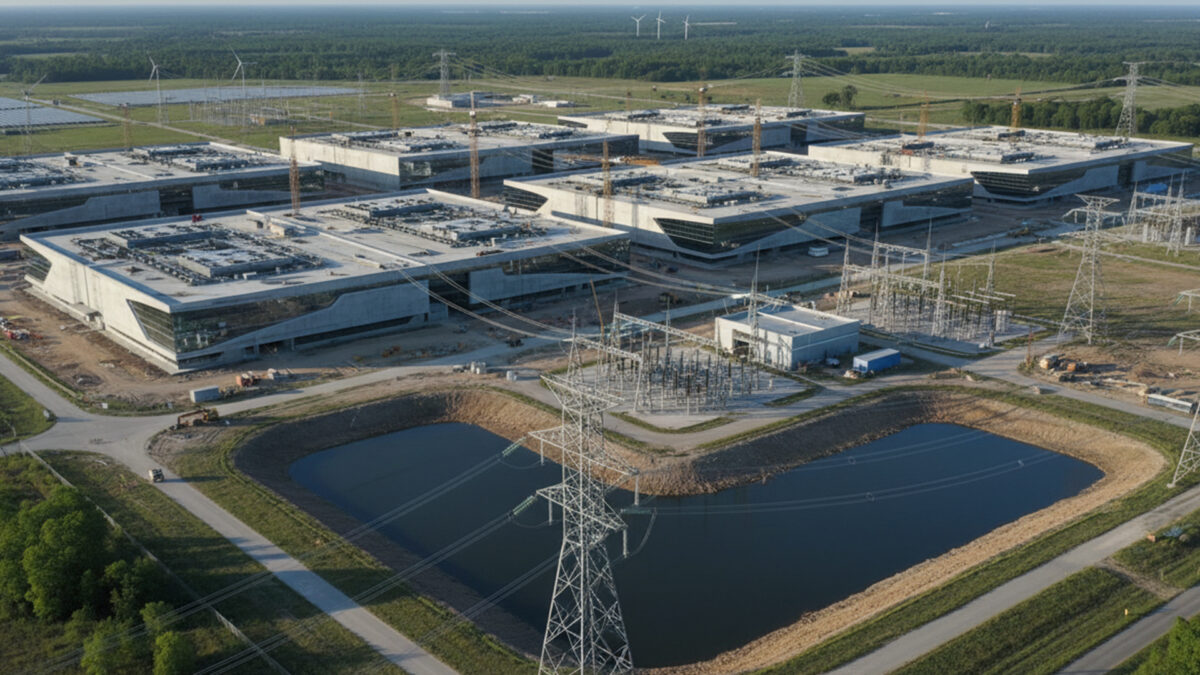
Meta Platforms has finalised a landmark financing package of approximately $30 billion to fund its Hyperion data center in Richland Parish, Louisiana—a move that could reshape how tech firms build AI infrastructure.
The transaction, reported on October 16 and 17 by multiple news outlets, marks the largest private capital deal ever structured in the technology and infrastructure sector.
Under the agreement, Meta and investment manager Blue Owl Capital will co-own the Hyperion site, with Meta retaining just a 20 percent stake and Blue Owl taking the majority share.
The deal is structured via a special purpose vehicle (SPV): Meta will not borrow the funds itself, but will act as the developer, operator and tenant of the data center. The SPV will carry more than $27 billion in debt and about $2.5 billion in equity, arranged by Morgan Stanley.
Pacific Investment Management Company (PIMCO) is anchoring much of the debt through 144A bond issuance. The bonds are being priced at roughly 225 basis points over U.S. Treasuries and carry an investment-grade A+ rating by S&P. (Morgan Stanley is the sole bookrunner.)
The Hyperion facility is expected to span nearly 4 million square feet and eventually draw as much as 5 gigawatts of power—enough to supply around four million U.S. homes—when fully operational by 2029.
The transaction structure allows Meta to deepen its AI compute capacity without burdening its balance sheet with direct debt. Analysts say this deal offers a model for hyperscalers seeking to scale infrastructure without weakening credit metrics.
Meta has been aggressively expanding its AI infrastructure this year. In August, the company tapped PIMCO and Blue Owl for a $29 billion financing plan to build out multiple compute hubs, including Hyperion and Prometheus.
The earlier arrangement would have combined $26 billion in debt and $3 billion in equity to drive Meta’s compute ambitions.
That earlier alignment underscores how long Meta has been negotiating with private credit markets to underwrite its infrastructure expansion.
The Hyperion deal comes at a time when hyperscalers are racing to scale AI systems across the U.S. and globally.
By structuring the financing off balance sheet, Meta is transferring much of the funding risk to institutional investors while retaining operational control.
Blue Owl and PIMCO, in turn, gain long-dated exposure to a physical asset serving as the engine for AI services.
Beyond the Louisiana project, Meta is pushing ahead on other data centers. The company recently announced a $1.5 billion investment in a new data center in El Paso, Texas, capable of scaling to 1 gigawatt.
That facility is expected to be operational by 2028. El Paso represents Meta’s 29th data center globally and its third in Texas. The new location was selected in part due to its strong electrical grid and workforce capabilities. Meta intends to match the energy used with 100 percent renewable sources and adopt water-efficient cooling systems to meet sustainability goals.
Meta’s CEO, Mark Zuckerberg, has publicly described a “supercluster” strategy: Prometheus is slated to go live in 2026 with over a gigawatt of compute, while Hyperion is designed to grow into a multi-gigawatt complex supporting Meta’s ambitions in large AI models, content inference, vision systems, and future applications.
He has also signaled intent to spend “hundreds of billions” in capital over time to underpin what Meta calls its superintelligence ambitions.
The sheer size of the Hyperion financing transaction underscores how capital markets are aligning behind AI infrastructure. The use of SPVs, long-dated bonds, and equity partnerships enables large-scale infrastructure development while giving investors access to stable, asset-backed returns.
However, the model carries risks: timely construction, technology execution, utility interconnection, real estate permitting, and macroeconomic interest rates could all pose challenges.
The closing of this deal not only cements Meta’s footprint in AI compute but also sets a precedent for how future exits in tech infrastructure may be funded.
As Cloud and AI competition intensifies among Meta, Microsoft, Google, and others, securing scalable capital for compute will likely become a strategic battleground.
Also Read: Jio Financial’s Q2 Profit Nears ₹700 Crore as Operating Income Surges