
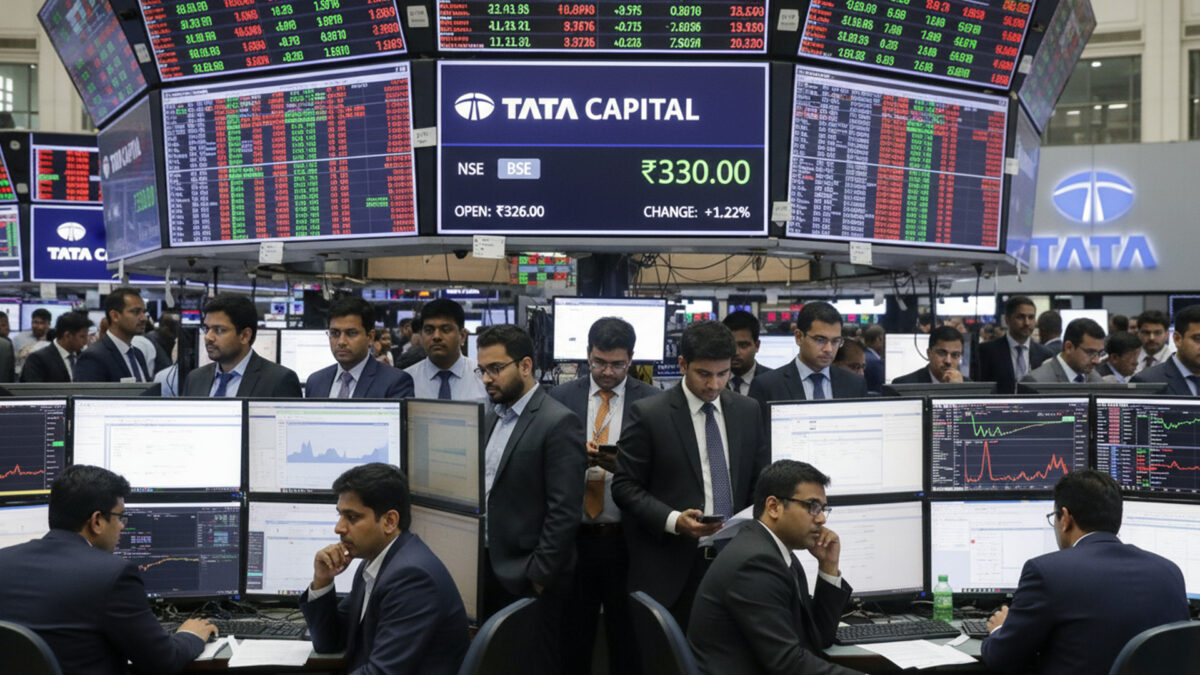
Tata Capital made a muted entry to India’s equity markets on Monday, with its shares listing only marginally above the offer price and failing to match the strong investor interest seen during the bookbuild.
The non-bank lender’s shares were quoted at ₹330 on both the National Stock Exchange and the Bombay Stock Exchange against an issue price of ₹326, implying a listing premium of about 1.2–1.3%.
The opening translated into a market capitalisation in the region of $15.7–15.8 billion.
The ₹15,512 crore public offering — one of the largest in India this year — had been fully subscribed at the close of the bidding period, with overall subscription reported at roughly 1.95 times.
Qualified institutional buyers accounted for the bulk of demand, while retail participation was more modest. The issue combined a fresh equity tranche and an offer-for-sale by existing shareholders; early anchor allocations included large institutional names.
Market commentators and analysts pointed to several factors behind the restrained debut.
Observers noted that, despite the IPO’s scale and the Tata brand, the company’s listing did not offer a significant valuation gap relative to listed peers in the financial-services and non-bank lending space — a dynamic that can dampen immediate aftermarket enthusiasm.
In addition, the timing of the listing coincided with other large issuances that captured investor attention, limiting incremental demand on listing day.
Brokerage notes published after the listing offered measured assessments of the stock’s near-term outlook.
Some houses suggested that, while the initial market response was tepid, the company’s underlying fundamentals and Tata affiliation could support upside over a longer horizon — with a small number of brokerages issuing 12-month target gains in double-digit percentage points.
These views were framed as forecasts rather than recommendations, and brokerage estimates varied. The outcome on listing day drew attention because it contrasted with earlier instances in which major private-equity and strategic investments in Indian retail and consumer-facing businesses attracted brisk secondary-market interest.
For context, General Atlantic’s investment in Reliance Retail in 2020 — which involved a multibillion-dollar stake purchase and helped establish a high benchmark valuation for large retail deals — is often cited as an example of the strong appetite that such marquee transactions can generate among global investors.
Analysts contrasted that level of demand with the more measured price action in Tata Capital’s debut.
Market participants will watch subsequent trading days for signs that the stock can build momentum beyond the opening session. Key metrics cited by analysts include Tata Capital’s earnings trajectory, asset quality and credit costs in the non-bank lending business, and how the company’s valuation compares with established peers over coming quarters.
Meanwhile, the issuance will remain a reference point in discussions about investor appetite for large-ticket IPOs in the current cycle and the premium, if any, investors are willing to pay for group-affiliated financial-services listings.
Also Read: TCS Reduces H-1B Usage, Aligns with U.S. Push for Local and High-Skilled Hiring