
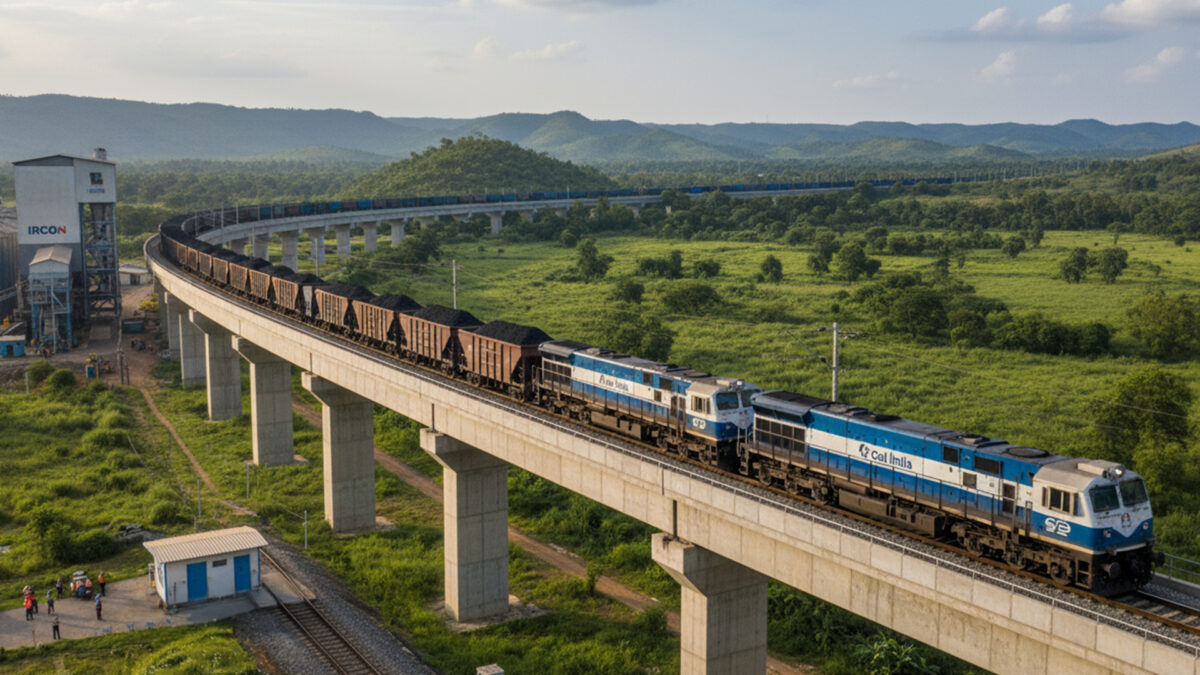
State-owned miner Coal India Limited (CIL) has signed a non-binding memorandum of understanding (MoU) with IRCON International to jointly develop rail infrastructure for CIL and its subsidiaries.
The agreement, announced on October 8, 2025, marks another step in CIL’s strategy to strengthen coal transportation through railways and reduce evacuation bottlenecks.
This is the latest in a series of partnerships aimed at enhancing first-mile and long-distance connectivity.
Earlier, in August 2025, CIL signed a similar pact with Konkan Railway, while in June it tied up with the Indian Port Rail & Ropeway Corporation for developing rail corridors.
These collaborations are part of a larger national push to modernise coal evacuation systems and improve energy logistics.
Strengthening rail logistics
Coal continues to be the largest contributor to Indian Railways’ freight business, accounting for nearly 50% of freight earnings and around 48–50% of total freight tonnage in recent years.
For the railways, coal is a critical revenue driver, contributing over ₹82,000 crore in FY 2022–23—about one-third of total earnings.
For CIL, rail remains the most cost-effective and environment-friendly mode of transporting coal from pitheads to consumers. However, congestion on key routes and limited connectivity near mines have long hampered evacuation efficiency. The new MoU aims to design, build, and upgrade rail corridors, sidings, spur lines, and mechanised loading systems to ensure faster, cleaner movement of coal.
In recent years, CIL has accelerated its First Mile Connectivity (FMC) projects—automated systems that load coal directly into railway wagons.
In FY 25, the company transported 102.5 million tonnes of coal through 20 such projects, a 34% increase over the previous year. It plans to commission 19 more FMC projects in FY 26, adding nearly 150 million tonnes of capacity annually.
Across India, 51 FMC projects with a combined capacity of 522 million tonnes per year are under various stages of implementation, eight of which are already operational.
Policy urgency and key projects
The Ministry of Coal has identified 38 priority rail projects nationwide to speed up coal evacuation and reduce logistics costs. Among these are the Gevra–Pendra Road double line and Kharsia–Dharmajaigarh phase one in Chhattisgarh, where officials have urged faster coordination between IRCON, CIL, and South Eastern Coalfields.
The Centre’s focus aligns with the broader goal of ensuring uninterrupted coal supply to power plants and industries, especially amid growing electricity demand.
Strengthened coordination between the Coal and Railways ministries is seen as crucial to achieving this.
Balancing growth with sustainability
Experts caution that while expanding rail capacity for coal improves efficiency and revenue, it could also worsen congestion in high-traffic corridors and delay other freight or passenger services.
Moreover, as India transitions toward renewable energy, the long-term dominance of coal in freight movement may gradually decline.
Still, for now, the MoU between CIL and IRCON represents an important step toward a more integrated, efficient, and mechanised coal transport system, supporting both India’s energy security and the railways’ economic backbone.