
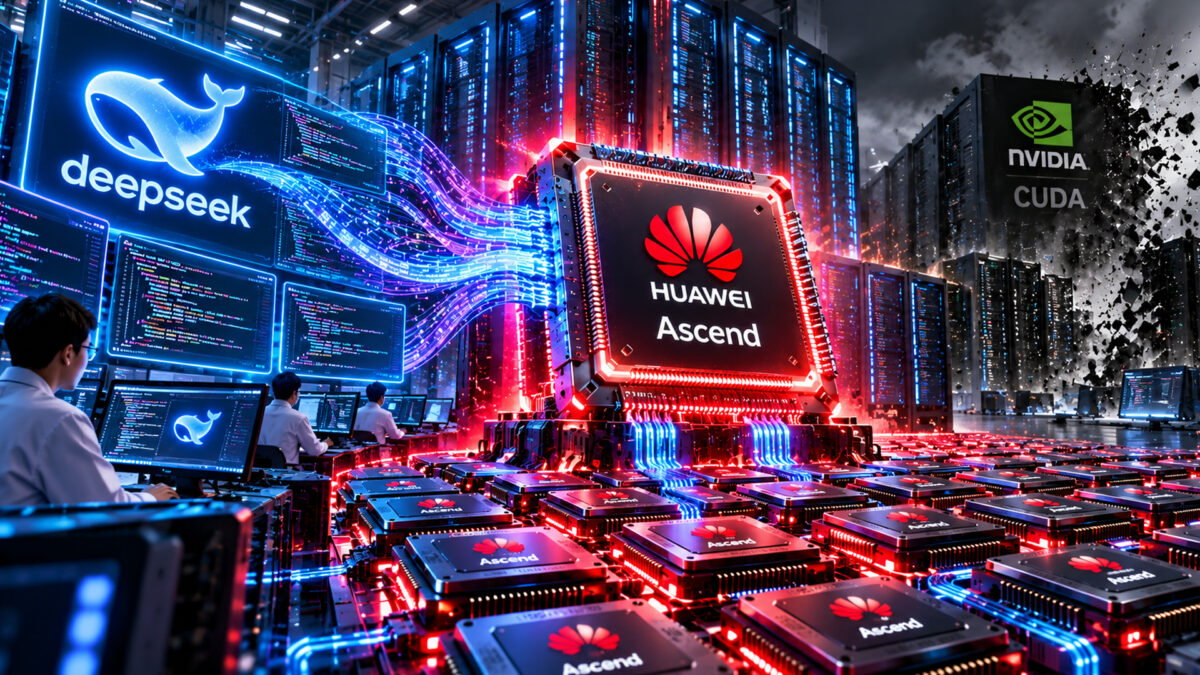
Chinese artificial intelligence company DeepSeek has partnered with Huawei Technologies to develop programming tools for Huawei’s Ascend AI chips, marking a fresh step in China’s push to build a stronger domestic AI technology ecosystem.
The partnership focuses on the software needed to make AI chips easier and more efficient to use. DeepSeek has released open-source programming infrastructure for Huawei’s Ascend platform, covering tools designed to support computation and communication between chips.
The move is significant because advanced AI hardware needs a strong software ecosystem to reach its full potential. Nvidia has built a major advantage through its CUDA software platform, which developers widely use to program and optimise AI workloads on Nvidia GPUs. DeepSeek and Huawei are now working on alternatives designed specifically for Chinese AI processors.
A key part of the collaboration is TileLang, an open-source programming language developed to simplify the process of programming AI chips. DeepSeek says the language allows developers to work at a higher level while still accessing the performance of the underlying hardware.
The goal is to make it easier to develop and optimise AI applications without relying heavily on Nvidia’s software ecosystem. DeepSeek has described the development of such programming infrastructure as an important step towards creating a more independent AI computing ecosystem.
The companies have also worked together on a computing system built around 128 Huawei Ascend 950 chips. Known as a “supernode”, the system is designed to allow a large number of AI processors to work together, improving computing and communication between the chips.
Huawei provided support for the programming infrastructure used by the system, according to DeepSeek. The development comes shortly after Huawei unveiled its next-generation AI processors and supernode systems, highlighting the company’s growing focus on large-scale AI computing.
The partnership also builds on earlier cooperation between the two companies. DeepSeek has been working to adapt its AI models to Huawei hardware, including its V4 model, which supports Huawei’s Ascend platform.
That shift is important because AI models require much more than powerful chips. Developers also need programming languages, compilers, libraries and communication systems that allow processors to work together efficiently. A strong software layer can reduce the amount of time developers spend rewriting and optimising applications for different hardware platforms.
TileLang is aimed at addressing part of that challenge. By providing a common programming framework, DeepSeek hopes developers can more easily build applications for Huawei’s AI chips while maintaining greater control over how the hardware is used.
The development comes against the backdrop of growing competition between China and the United States over advanced semiconductor and AI technology. Restrictions on the export of some advanced US chips and technology to China have pushed Chinese companies to accelerate the development of domestic alternatives.
Huawei has emerged as one of the key players in that effort, particularly through its Ascend AI chip range. DeepSeek’s involvement adds the expertise of one of China’s most closely watched AI companies to the software side of Huawei’s semiconductor strategy.
Open-source development could also help the new ecosystem attract more developers. Giving programmers access to the underlying tools allows them to experiment, adapt the software and contribute improvements. A larger developer community could eventually help expand the number of applications that can run efficiently on Huawei hardware.
Still, building a credible alternative to Nvidia’s established ecosystem will take more than releasing new software. Developers will look at performance, reliability, compatibility, documentation and hardware availability before moving large AI workloads to a new platform.
The 128-chip Ascend 950 supernode is an important technical development, but its chip count alone does not establish how it compares with Nvidia-based systems. Meaningful comparisons would require independent testing under similar workloads, hardware configurations and software conditions.
The DeepSeek-Huawei partnership therefore represents a broader shift in China’s AI strategy. The focus is moving beyond simply producing domestic AI chips towards building the software and infrastructure needed to make those chips competitive and practical at scale.
DeepSeek brings experience in developing and optimising large AI models, while Huawei brings its Ascend processors and computing infrastructure. Their collaboration aims to connect those two strengths through a stronger software layer.
The bigger challenge is reducing dependence on established foreign technologies while giving developers a practical alternative. Success will depend on how quickly the tools mature and how widely they are adopted by China’s growing AI industry.
China’s AI chip race is consequently becoming a race over software as much as hardware. Powerful processors need efficient programming tools, and DeepSeek and Huawei are betting that an open-source ecosystem can help close that gap.
The latest partnership could give Chinese developers another route to build and run AI systems using domestic technology, while adding momentum to Huawei’s wider effort to develop an alternative AI computing ecosystem.