
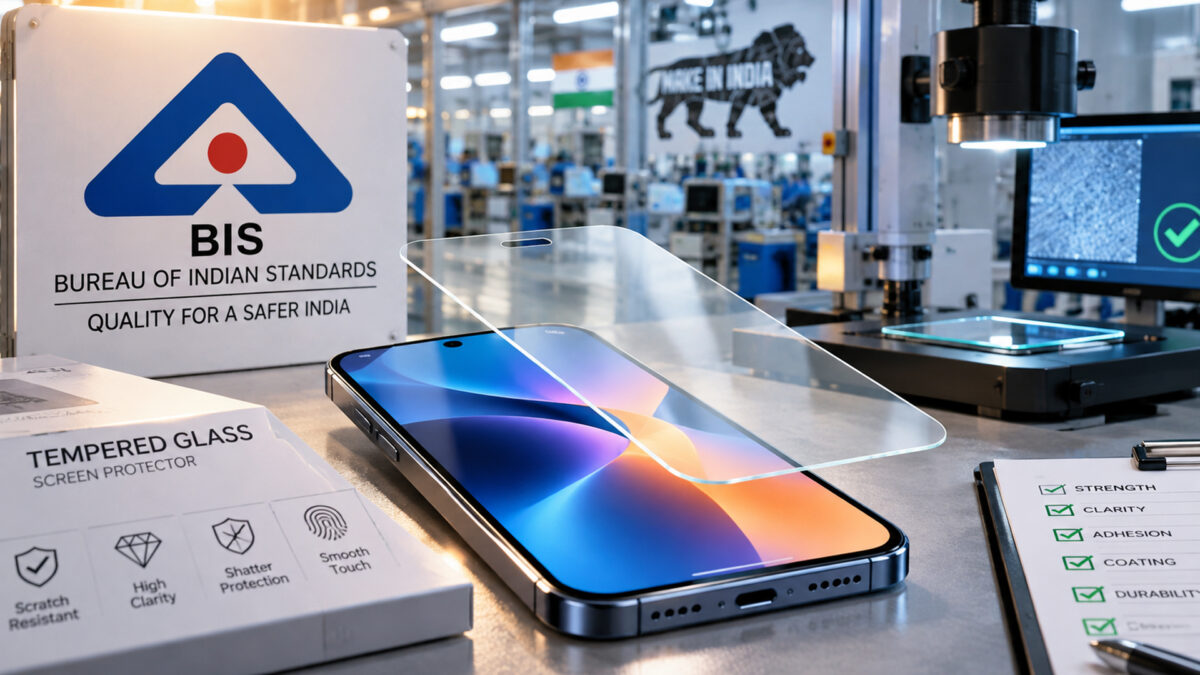
Buying a screen protector for a smartphone could soon become a more regulated process in India. The government has brought smartphone screen protectors under mandatory Bureau of Indian Standards (BIS) certification, with the new rules coming into effect from April 1, 2027.
The move is aimed at improving the quality of screen guards and tempered glass products sold in the country and reducing the presence of substandard products. Manufacturers and importers will have to ensure their products meet the prescribed Indian Standard before they can be legally sold in India.
The Ministry of Electronics and Information Technology (MeitY) added “Screen Protectors for smartphones” to the compulsory registration framework through a notification dated September 21. The products will have to comply with IS 19348:2025, the Indian Standard for glass screen protectors.
Companies have been given more than six months to prepare for the new requirement. From April 1 next year, screen protectors that do not meet the standard will not be allowed to be manufactured, imported, stored for sale, sold or distributed in India.
The new rules are expected to bring greater consistency to a market that currently has products ranging from branded tempered glass to very low-cost and unbranded screen guards.
For consumers, the biggest change may be the quality of the product rather than the way it is bought. The new Indian Standard covers several aspects of a screen protector, including its dimensions, thickness, strength, optical clarity and visible defects. Products will also have to meet requirements related to features such as adhesives, coatings and protective layers.
The BIS framework is particularly relevant because a screen protector is often the first layer of protection for a smartphone display. Poor-quality products can affect touch sensitivity, clarity and the overall viewing experience, while weak glass may fail to provide adequate protection during a fall.
The government has not announced a fixed price increase for screen protectors. However, manufacturers and importers may face additional testing and compliance costs under the new system. Whether those costs eventually translate into higher retail prices will depend on individual companies and market conditions.
The move could also change the competitive landscape for India’s screen protector industry.
Industry estimates put the domestic market at around 400 million tempered-glass screen protectors, with annual sales worth about ₹20,000 crore in 2025. Another industry estimate puts the broader market at ₹12,000 crore to ₹15,000 crore annually, with consumers buying more than 500 million protectors each year. The different estimates reflect the difficulty of tracking a market that has a large unorganised and import-dependent segment.
A large share of products currently comes from imports, particularly from China. Industry bodies have argued that low-priced imports and grey-market products make it difficult for domestic manufacturers to compete.
The mandatory BIS certification could therefore give Indian manufacturers a more level playing field. It could also encourage companies to expand local production of tempered glass and other smartphone accessories.
Optiemus Infracom is among the companies preparing for the change. The company already manufactures screen protectors in India and plans to add capacity of 2 crore units. It expects shipments from its Noida facility to begin in January 2027.
The company has said the new standards could help create a more organised Made-in-India screen protector ecosystem. Industry representatives have also pointed to possible gains in local value addition, employment and manufacturing capacity.
The Indian Cellular and Electronics Association (ICEA) has supported mandatory quality standards, saying they could help protect consumers from substandard products while creating a level playing field for domestic and international manufacturers. The industry body has also estimated that the move could create significant employment across manufacturing and related sectors.
The new rule is part of a broader government effort to bring more electronic products under mandatory quality and safety requirements. The compulsory registration framework already covers products such as smartphones, laptops, chargers, televisions, printers and other electronic equipment. Screen protectors have now been added as the 66th product category under the framework.
The change will not affect consumers immediately. Existing products can continue to be sold before the new requirement takes effect, subject to the applicable rules. Manufacturers and importers now have the transition period to test their products, obtain the required approval and adjust their supply chains.
The bigger impact will be visible from April 2027, when compliance with BIS standards for smartphone screen protectors becomes mandatory.
The change could eventually make it easier to distinguish between products based on quality rather than price alone. For manufacturers, it means additional compliance but also an opportunity to expand domestic production.
The government’s stated objective is straightforward: ensure that screen protectors sold in India meet a common quality benchmark. The new BIS rules could reshape a largely fragmented market while giving consumers greater confidence in one of the most commonly purchased smartphone accessories.