
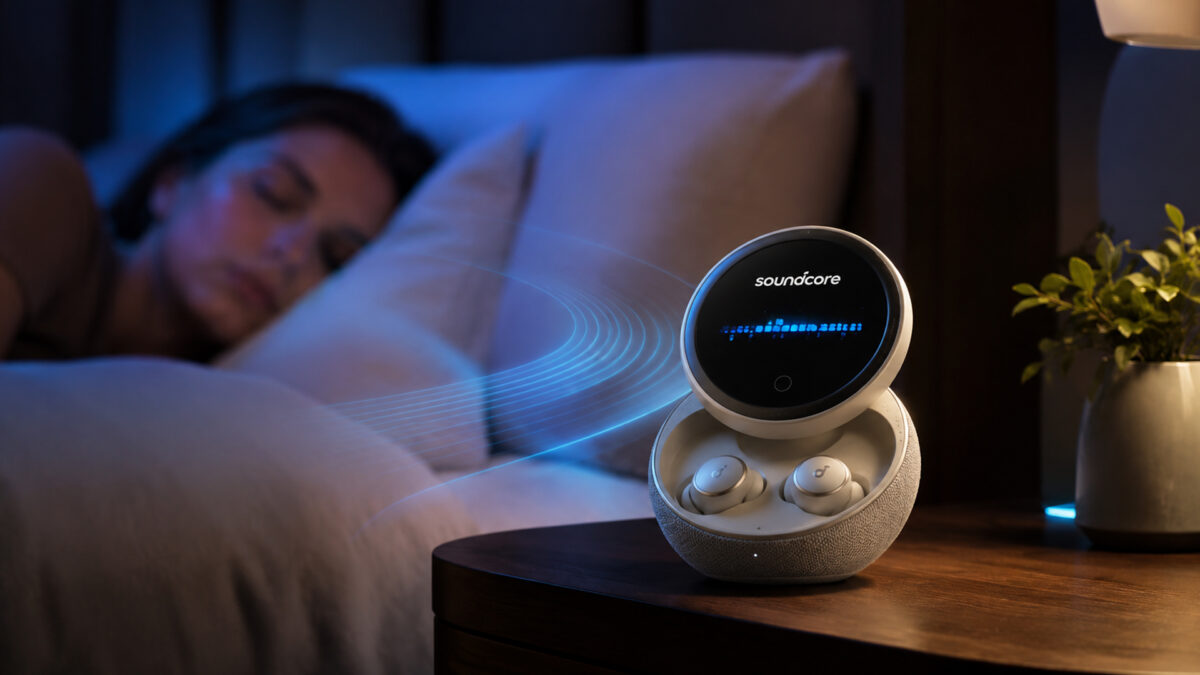
Anker is taking sleep tracking off the wrist and moving it to the bedside. The company has unveiled the SleepLab Pro, a smart speaker that can monitor sleep without requiring users to wear a smartwatch, fitness band, smart ring or earbuds while in bed.
The device was introduced at IFA 2026 in Berlin as part of Anker’s expanding focus on health, wellness and sleep technology. Instead of placing sensors directly on the body, the SleepLab Pro sits beside the bed and uses radar to collect information during the night.
The technology behind the device is a 60GHz millimetre-wave radar system. It detects very small movements from the person sleeping, including movements associated with breathing. The collected information is then used to track sleep patterns and provide estimates of metrics such as heart rate and breathing rate.
The approach addresses one of the biggest limitations of wearable sleep trackers: not everyone enjoys wearing a device overnight. Smartwatches can feel uncomfortable, rings can take some getting used to and sleep earbuds are not suitable for everyone. Anker’s solution is designed to work in the background, allowing users to go to bed without putting anything on.
SleepLab Pro can monitor different stages of sleep and provide users with information about their night. The device is designed to help people understand their sleeping patterns and identify changes over time rather than simply recording when they went to bed and woke up.
Anker is also positioning the product as more than a sleep-monitoring device. The speaker combines sleep tracking with features intended to make the bedtime environment more relaxing. It includes a collection of more than 180 sounds that users can play while preparing for sleep or during the night.
The company is also promoting personalised audio experiences and a 28-day sleep programme aimed at helping users develop more consistent bedtime habits. The idea is to turn sleep data into practical routines rather than leaving users with a collection of numbers that may be difficult to understand.
A built-in night light adds another element to the device. Users can incorporate the speaker into their existing bedtime routine, using it for lighting, sounds and alarms while the radar system works in the background.
One of the more notable aspects of the SleepLab Pro is its subscription-free approach. Anker says the core sleep-monitoring features will not require users to pay a recurring subscription. That could give the product an advantage in a market where several health and fitness platforms charge monthly or annual fees for access to detailed insights.
The launch is part of a wider expansion of Anker’s sleep-focused product range. The company has also introduced the Sleep Earbuds 4 and Sleep Earbuds 4 Pro, which take a more conventional wearable approach. Those products place sensors directly in the ears and combine sleep monitoring with audio.
SleepLab Pro takes the opposite route. Rather than asking users to wear technology, it attempts to make monitoring completely contactless. The concept reflects a broader shift in consumer electronics towards devices that operate passively and require less interaction from users.
Radar-based monitoring could also offer practical benefits beyond comfort. Because the device remains on the bedside table, users do not have to remember to charge or wear a tracker before going to sleep. The system can potentially monitor sleep every night without changing the user’s routine.
However, the technology also raises questions about privacy. A device that continuously monitors a person while they sleep could collect highly personal information about sleeping patterns and other physiological signals. As health technology becomes more common inside homes, consumers are likely to pay greater attention to how such information is stored, processed and protected.
The SleepLab Pro should also be viewed as a consumer wellness product rather than a medical device. Sleep trackers can provide useful information about patterns and habits, but their measurements and estimates are not equivalent to those obtained through clinical sleep studies. Anyone experiencing persistent or serious sleep problems should seek professional medical advice rather than relying solely on consumer technology.
Anker has not yet announced complete pricing and availability details for every market. More information is expected as the company moves closer to the product’s commercial launch.
The introduction of SleepLab Pro highlights how quickly sleep technology is evolving. What began largely with basic fitness bands and smartwatches has expanded into smart rings, specialised earbuds, mattresses, bedside sensors and now radar-equipped speakers.
Sleep tracking can provide useful insights, but the best tracker is often the one people are comfortable using consistently. By moving the sensors away from the body, Anker hopes to remove one of the main barriers to overnight monitoring.