
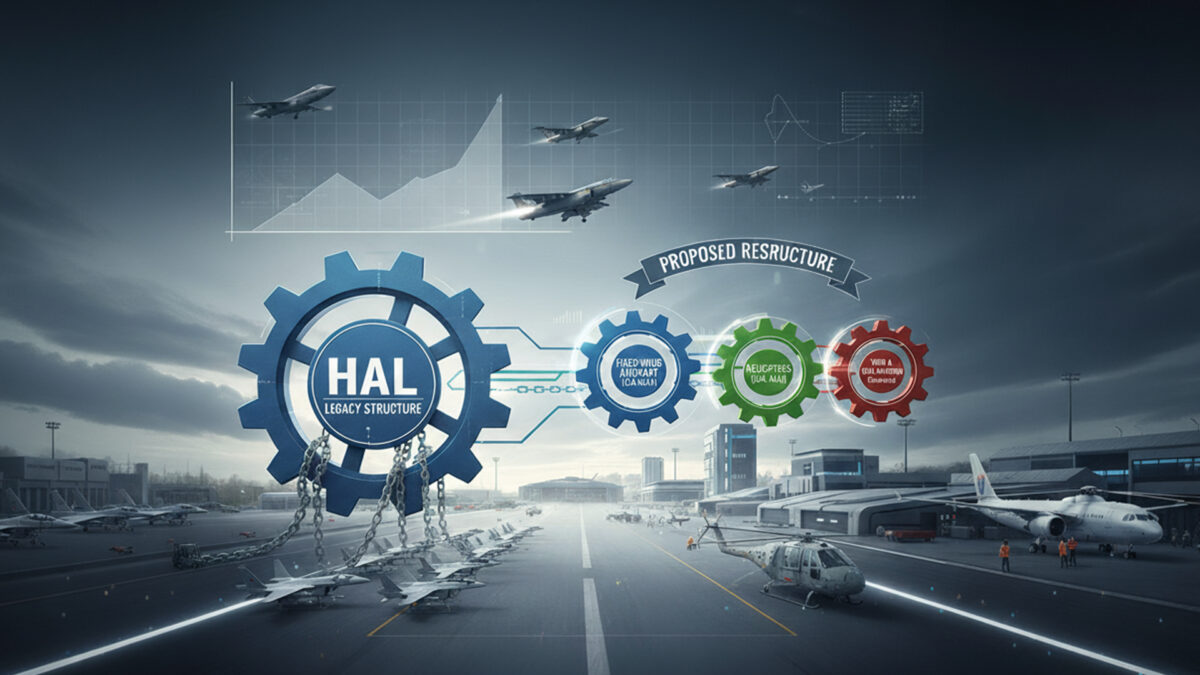
The Indian government is exploring a comprehensive restructuring of Hindustan Aeronautics Limited (HAL) to boost its operational efficiency and accelerate its ability to meet defence procurement timelines.
An external consulting firm has been engaged to design a strategic roadmap that could transform HAL’s current structure, the Economic Times has reported. One of the leading ideas under discussion is to split HAL into multiple independent entities, each focused on a particular domain such as fixed-wing aircraft manufacturing, helicopters, and maintenance, repair and overhaul (MRO).
The overhaul is being considered in view of HAL’s expanding order backlog and performance challenges. The defence PSU is said to be managing a record order book exceeding ₹2.7 lakh crore, covering fighter jets, helicopters, engines and other aeronautical platforms. As delays in deliveries have become a growing concern, the proposed restructuring aims to ensure that HAL can respond more nimbly to the needs of the armed forces.
According to reports, the plans are still in nascent stages and under deliberation. The roadmap may create discrete units dedicated to design, manufacturing, MRO services, and supply chain operations. Previously, similar restructuring ideas were considered but shelved when HAL’s order volumes were smaller.
The government’s interest in reforming HAL coincides with recent large defence contracts awarded to the company. In a recent procurement, the Ministry of Defence signed a deal worth over ₹62,370 crore with HAL for 97 Light Combat Aircraft (LCA) Mk-1A jets, which underscores the scale and importance of HAL’s upcoming commitments.
HAL has also begun to diversify its operations. Its Nashik MRO facility has expanded into civilian aircraft overhauls—recently servicing Airbus A320s and Embraer jets under a collaboration with Airbus. This move into civil aviation maintenance is seen as a push to leverage HAL’s technical infrastructure beyond defence production.
The restructuring, if approved, would mark a significant shift for HAL, which already holds Maharatna status, granting it enhanced financial and operational autonomy. Observers suggest that a leaner, domain-focused structure could reduce bottlenecks, improve accountability, and generate more specialization within HAL’s divisions.
However, there are challenges ahead. Deciding how to divide assets, allocate liabilities, preserve institutional knowledge, retrain employees, and manage transition costs will demand detailed planning. Moreover, the move will likely require approvals from multiple arms of government and the defence establishment.
As of now, no formal announcement has been made. The government continues to deliberate on the proposal, weighing the benefits against the complexity of reengineering a legacy defence enterprise.
Also Read: FADA President: Hatchbacks Here to Stay Despite Rising SUV Dominance