
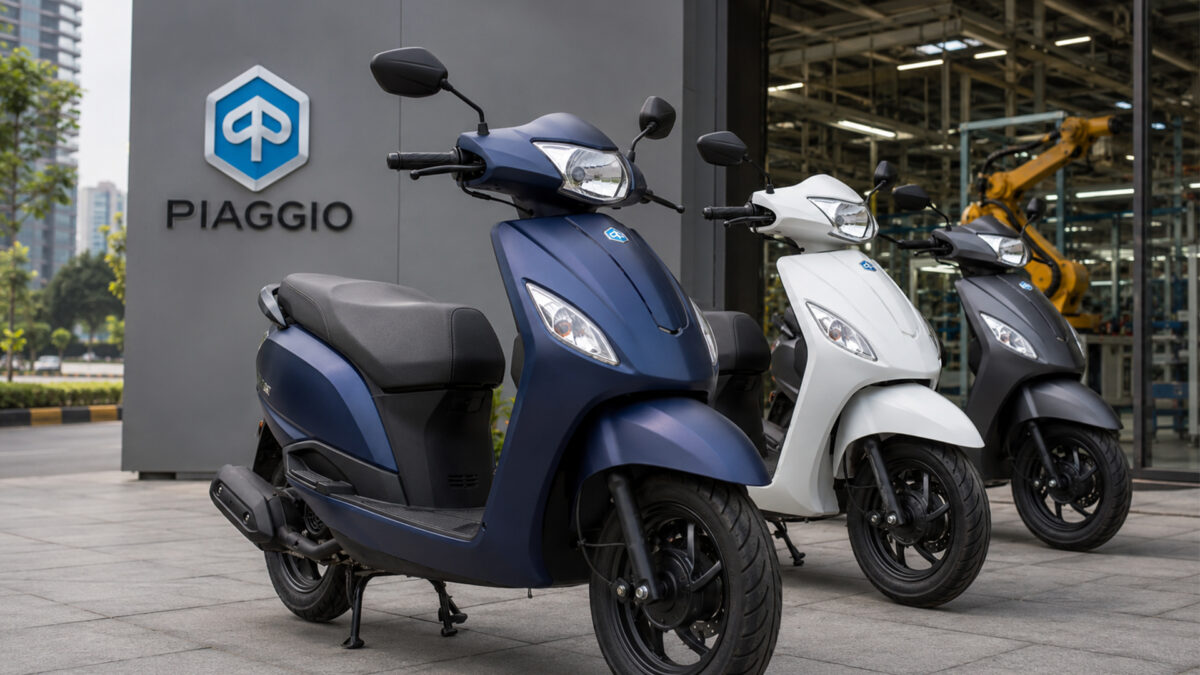
Italian two-wheeler manufacturer Piaggio is preparing to make its biggest move yet in the Indian scooter market. Known for its premium Vespa and Aprilia scooters, the company is now working on an entirely new range of affordable commuter scooters that will be designed, developed and manufactured in India. The new lineup is expected to be launched in the first half of 2027, marking Piaggio’s entry into one of the country’s most competitive and high-volume two-wheeler segments.
The upcoming scooters are aimed at everyday riders who prioritise practicality, fuel efficiency and affordability. This is a significant shift for Piaggio, whose current India portfolio largely caters to premium customers. By entering the commuter segment, the company hopes to increase its market share and tap into millions of potential buyers.
Unlike its existing scooters, the new products are being built on a completely fresh platform created specifically for Indian conditions. The company says this platform will not be limited to a single model but will support an entire family of scooters. Multiple variants with different features and specifications are expected, allowing Piaggio to target a wide range of customers across price points.
Piaggio Vehicles Chairman and Managing Director Diego Graffi said the project is progressing as planned and will result in a new range of scooters developed for India. Instead of extending the Vespa or Aprilia brands into the commuter category, the company will introduce a completely new brand dedicated to this segment. This will allow Piaggio to clearly separate its premium offerings from its mass-market products.
The decision reflects Piaggio’s long-term strategy for India. Vespa will continue to represent stylish, premium scooters inspired by Italian heritage, while Aprilia will remain focused on sporty and performance-oriented models. The new commuter brand, meanwhile, will concentrate on practical mobility solutions for daily use.
India is one of the world’s largest scooter markets, with annual sales touching nearly six million units. The segment continues to be dominated by established players such as the Honda Activa, TVS Jupiter, Suzuki Access and Hero Xoom. These models have earned consumer trust through reliability, low maintenance costs and fuel efficiency. Piaggio believes there is still room for another strong contender, provided it offers the right combination of quality, pricing and features.
For years, Piaggio has maintained only a niche presence in India because its scooters have largely been positioned in the premium category. While Vespa enjoys a loyal customer base, sales volumes remain relatively small compared with mainstream commuter scooters. The upcoming India-focused range is expected to change that by helping the company compete in the country’s largest two-wheeler segment.
The scooters will be manufactured at Piaggio’s Baramati facility in Maharashtra, which already produces Vespa and Aprilia models for both domestic and export markets. Local production will allow the company to increase localisation levels, reduce manufacturing costs and remain competitive on pricing. It also supports the government’s push for greater domestic manufacturing under the ‘Make in India’ initiative.
Although Piaggio has not disclosed technical details, the new architecture is expected to be modular and flexible. This means it can support multiple scooter models and potentially different powertrain options in the future, depending on market demand and regulatory requirements. Such flexibility will also enable the company to introduce updated versions and new variants without developing an entirely new platform every time.
The company has remained tight-lipped about engine specifications, design, pricing and feature lists. However, industry experts believe the scooters will focus on everyday usability, comfortable riding, good fuel economy and modern convenience features to compete effectively against established rivals. Buyers in this segment increasingly expect digital instrument clusters, smartphone connectivity, LED lighting and ample storage space, making these likely additions to the upcoming models.
Piaggio’s decision to develop the scooters in India also underlines the country’s growing importance as a global engineering and manufacturing hub. Instead of adapting products designed for international markets, the company is building these scooters around the needs of Indian customers. This approach is expected to help deliver products that are better suited to local roads, traffic conditions and consumer preferences.
Despite its expansion into the commuter space, Piaggio has clarified that it will continue investing in its premium portfolio. Vespa and Aprilia will remain key pillars of the company’s India strategy, with new models and updates expected in those segments as well. The new commuter brand will complement the existing lineup rather than replace it.
The move comes at a time when competition in the Indian two-wheeler industry is intensifying. Manufacturers are introducing new petrol and electric scooters while focusing heavily on localisation, affordability and advanced technology. By entering the commuter segment with a dedicated India-made platform, Piaggio is positioning itself to compete more aggressively in a market that continues to witness strong demand.
While customers will have to wait until 2027 for the first scooters to reach showrooms, Piaggio’s announcement signals a major change in its India strategy. If the company can combine competitive pricing, dependable performance and modern features with its engineering expertise, the new Made-in-India commuter scooter range could significantly strengthen its presence in India’s booming two-wheeler market and offer buyers another credible alternative in the country’s most popular scooter segment.