
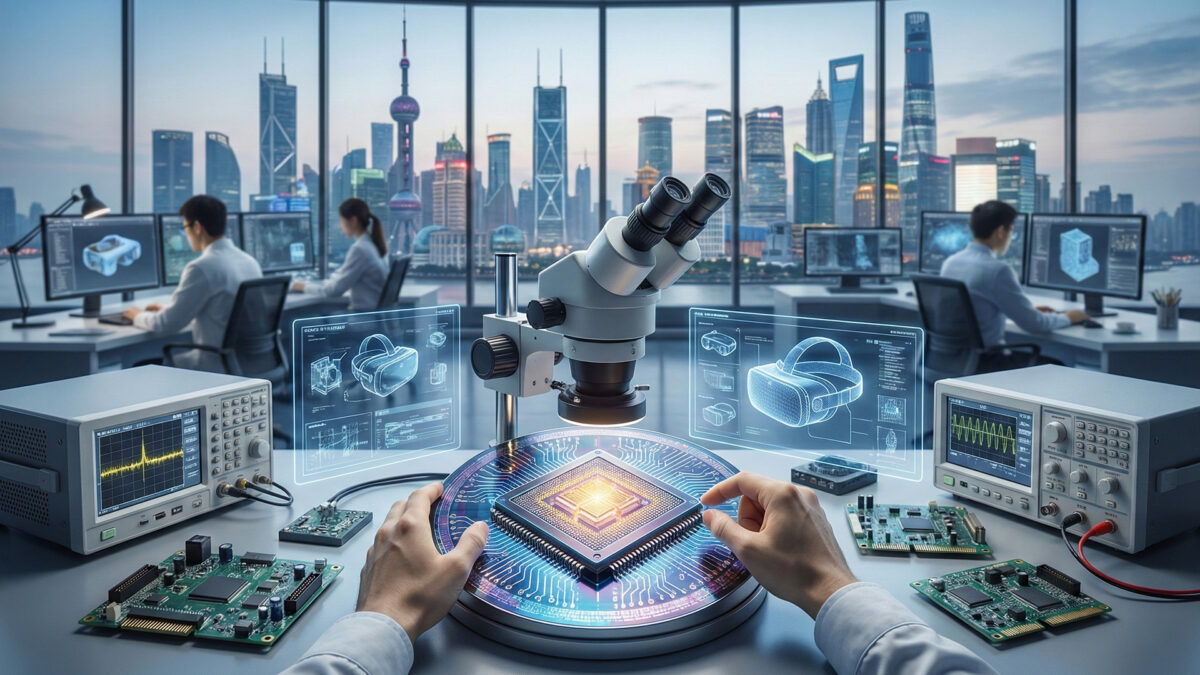
A former Apple engineer has launched a new XR processor. It could shake up the global mixed-reality market. Wang Chaohao, who worked on Apple’s Vision Pro, now heads the Chinese startup GravityXR. His company has developed the Jizhi G-X100, a 5-nanometre chip for AR, VR, and mixed-reality headsets.
The G-X100 is the first Chinese XR chip built on a 5 nm process. It promises higher performance and better power efficiency. One key feature is its photon-to-photon latency of just 9 milliseconds. This measures the time between user movement and updated visuals. Most premium headsets have 10–12 ms. Lower latency means smoother visuals and less motion discomfort.
The chip supports both lightweight AI glasses and high-performance XR headsets. It is built for spatial computing, which lets devices understand real-world environments and blend them with digital content. The chip includes a graphics engine, AI accelerators, and sensor-fusion modules for real-time mapping, gestures, and mixed-reality rendering.
The launch also reflects China’s push to build domestic XR technology. GravityXR has attracted top investors, a major wearable manufacturer, and a gaming studio. With this support, the startup is emerging as a serious global XR competitor.
If the G-X100 performs as claimed, it could power headsets that are thinner, lighter, and faster than existing models. This could rival or even surpass established global devices. The company hopes to drive wider adoption of advanced XR by offering a high-performance, cost-effective chip.
With spatial computing set to transform gaming, education, healthcare, and work, the race to build the most capable XR chip is heating up. GravityXR is now a key player in that race.
Also Read: Trump receives FIFA Peace Prize for global leadership