Categories
Corporate

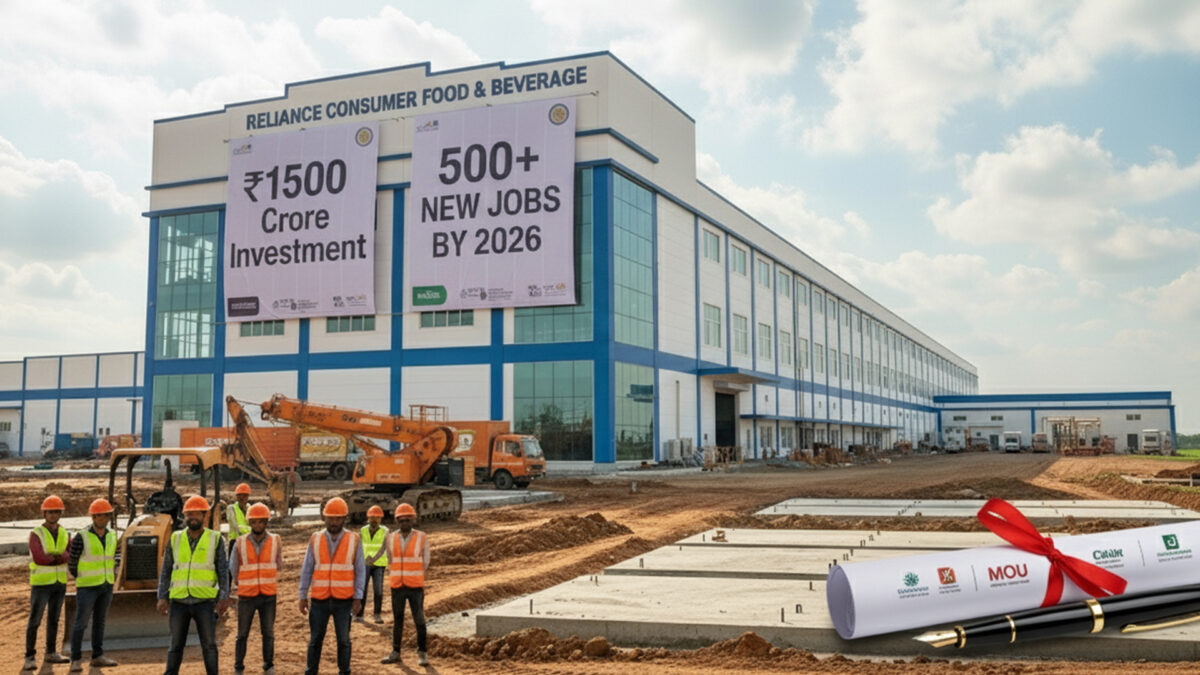
Reliance Consumer to Invest ₹1,500 Crore in Nagpur Food Processing Plant by 2026

Reliance Consumer Products Ltd (RCPL), the FMCG arm of Reliance Industries Limited, has announced a significant investment of over ₹1,500 crore to set up a state-of-the-art integrated food and beverage manufacturing facility in Katol, near Nagpur, Maharashtra. The new unit is slated to be operational by 2026 and is expected to create more than 500 direct jobs.

The investment forms part of RCPL’s aggressive expansion strategy in the food processing sector, aimed at strengthening its footprint in the fast-growing FMCG market. The company has recently signed a Memorandum of Understanding (MoU) with the Maharashtra government, which has pledged to provide all necessary approvals, clearances, and financial incentives to facilitate the project.

RCPL has seen rapid growth since its inception, crossing ₹11,000 crore in revenue within just three years, fueled by its strong retail network and expanding portfolio of brands. The upcoming Nagpur facility will bolster the company’s manufacturing capabilities and support its ambition to become a leading player in India’s FMCG landscape.

The Maharashtra government, keen on attracting major industrial investments to drive economic growth and employment, welcomes Reliance’s commitment. This move aligns with the state’s broader objective to develop Nagpur and its surroundings as a hub for food processing and allied industries.

With this investment, Reliance Consumer Products not only aims to meet rising consumer demand for packaged foods but also contribute to regional industrial development and job creation, reinforcing Maharashtra’s position as a preferred investment destination.


Categories
Corporate

Bharat Forge Partners with UK’s Windracers to Deploy Advanced Cargo UAVs in India

Bharat Forge has entered into a strategic partnership with UK-based Windracers Limited to bring the ULTRA unmanned aerial vehicle (UAV) technology to India. The agreement, formalized through a Memorandum of Understanding (MoU) at the DSEI UK 2025 defence exhibition in London, aims to enhance India’s UAV capabilities by localizing production and operational deployment.

The initial two-year pact focuses on jointly conducting trials, localizing the ULTRA UAV platform, and developing tailored deployment strategies to meet the diverse needs of Indian defence and civil sectors. This collaboration supports the broader framework of the UK-India Free Trade Agreement and aligns with the India-UK Vision 2035 initiative to foster technological innovation and strategic cooperation.

Amit Kalyani, Joint Managing Director of Bharat Forge, emphasized that the partnership will significantly boost India’s indigenous UAV capabilities and address critical logistics challenges across difficult terrains. The ULTRA UAV, already proven in extreme environments such as Antarctic research missions, is well-suited for a variety of applications, including Carrier On Board Delivery (COD) operations for the Indian Navy, and logistical support for the Indian Army and Air Force.

Simon Muderack, CEO of Windracers, highlighted that this collaboration represents a key milestone in expanding the operational reach of ULTRA UAVs, offering strategic advantages and operational independence to Indian defence and civilian agencies.

This partnership reflects Bharat Forge’s commitment to advancing India’s defence and aerospace sectors through innovation and international partnerships, paving the way for future growth and technological self-reliance.

Categories
Corporate

Oracle Stock Retreats After Record Surge Driven by AI Cloud Optimism

Oracle Corporation’s shares fell sharply on Thursday, closing down 6%, a day after hitting a record high, as investor sentiment shifted due to concerns that most of the company’s near-term growth is heavily dependent on a single client,  OpenAI.

Earlier this week, Oracle’s stock soared on the back of strong quarterly performance and bullish projections. On Tuesday, CEO Safra Catz revealed that Oracle had “signed four multi-billion-dollar contracts with three different customers” during the latest quarter, causing shares to surge 30% in extended trading. On Wednesday, the stock jumped nearly 36%, closing at a record high of $328.33, and briefly lifting Oracle’s market capitalization to $933 billion.

The company’s remaining performance obligation – the measure of contracted but unrecognized revenue – ballooned to $455 billion, a remarkable 359% increase year-over-year. Oracle forecasted that its cloud infrastructure revenue would grow 14-fold by 2030, positioning itself as a key player in the AI cloud services market. The company’s build-out of data center capacity is part of a broader strategy to support AI-driven applications, especially those relying on Nvidia chips.

However, the excitement was tempered after a report by The Wall Street Journal revealed that OpenAI is expected to pay Oracle $300 billion over five years under a major agreement to build 4.5 gigawatts of U.S. data center capacity. Both companies declined to comment on the report.

Gil Luria, an analyst with a neutral rating on Oracle shares, noted in a client advisory that “our enthusiasm for Oracle’s backlog announcements is significantly tempered by the report that it came almost entirely from OpenAI.”

As a result, Oracle’s shares slid nearly 6% on Thursday, closing at $307.86 per share, down $20.68 from the previous close. The stock saw an intraday high of $335.39 and a low of $304.65, with a trading volume of 69.98 million shares. The stock opened at $330.00.

Despite the pullback, analysts believe the stock remains about 9% below the median price target of $342, signaling that many investors continue to view Oracle’s long-term prospects favorably.

Larry Ellison, Oracle’s co-founder, saw his net worth rise to approximately $387.6 billion, largely due to his 41% stake in the company, making him second only to Elon Musk on Forbes’ global wealth list.

The recent stock correction is seen as a market reaction to the concentration risk in Oracle’s growth strategy, with investor focus now shifting to how the company will diversify its client base and sustain its ambitious AI cloud expansion in the coming years.