
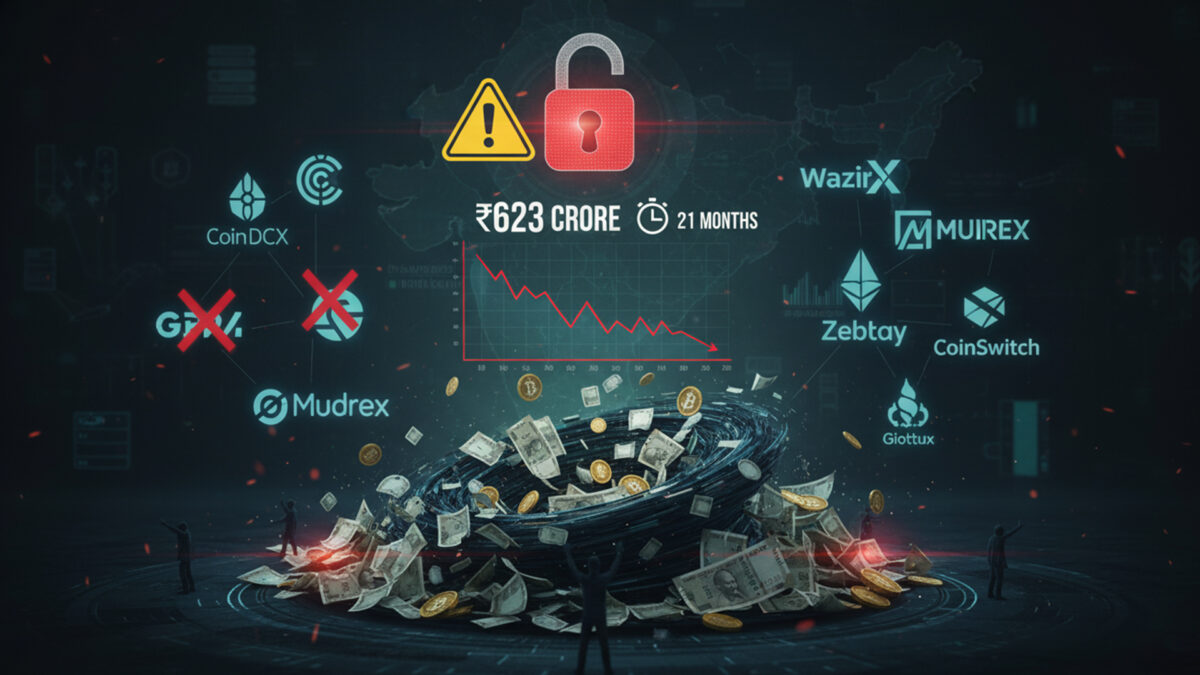
A government-backed investigation has uncovered a large-scale crypto-laundering network operating across India, with cybercriminals allegedly siphoning ₹623 crore through 27 domestic cryptocurrency exchanges over a span of 21 months. The findings, drawn from a collaborative global probe called “The Coin Laundry,” shed light on how stolen money is being systematically channelled through India’s fast-growing digital asset ecosystem.
Data compiled by the Indian Cyber Crime Coordination Centre (I4C) shows that funds taken from 2,872 victims, mostly through online investment frauds, job scams and loan app traps, were quickly converted into cryptocurrency and moved through exchanges before being routed overseas. Investigators identified suspicious flows in at least 144 cybercrime cases tracked over the past three years.
The scale of laundering varied significantly across platforms, with one exchange seeing inflows of more than ₹360 crore, while another recorded around ₹6 crore. Major platforms, including WazirX, CoinDCX, ZebPay, Giottus, Mudrex and CoinSwitch, feature in the list of exchanges flagged for further scrutiny.
Officials caution that the reported figure may represent only a fraction of the actual laundering activity. The nature of blockchain transactions, combined with inconsistent compliance standards across exchanges, has made it easier for criminal networks to exploit weak verification and monitoring systems. Investigators are examining possible failures in Know Your Customer (KYC) and anti-money laundering (AML) protocols.
The probe has also thrown up unusual links. One suspect associated with the laundering ring, believed to be of Russian origin, was connected to a film featuring Hollywood actor Kevin Spacey and Bollywood actor Disha Patani, held investor events in India and even hosted a birthday celebration in Mumbai for Maye Musk, mother of Elon Musk.
The revelations come at a time when India is still framing its long-term policy on cryptocurrency regulation. The findings underscore the need for stronger oversight, clearer compliance standards and faster reporting mechanisms to prevent exchanges from becoming conduits for global criminal networks.
Also Read: Microsoft, Nvidia invest $15 billion in Anthropic